Monday, January 27, 2014

Looking at things from all angles... and a NEW VIDEO!


The other day I was handed this small branch with a cluster of pods at its head. Passed on by a friend of my mother's to me there was no name offered and I was simply told it had yellow flowers and grew at her house. 


Tonight I thought I might draw it but when picking it up, the seeds kept on falling out. That distracted me somewhat so I took out my i-phone to see if I could take some shots that might prove helpful to draw from. As the results from the iPhone are so variable I was unsure if I'd get what I wanted.


Too yellow... too unclear... too rough... too everything really!


I persisted in order to see the seeds from various angles and appreciate both the form of the pods and the seeds.


This one was quite natural in appearance

Trying to get closer was hard.


Some of the shapes really appealed as I looked closer.


Tonal qualities accentuated


Closer


I liked the seeds in this one


Photos taken under a light


I'll come back and draw these this week.


A poor image looked slightly better in black and white.


This colour was quite true to life really.


Textural pods on the lower half of this one


were in high contrast to this one above


seeds


interesting to see the details in form... at first glance they seem all the same


I'd like to see these under a microscope


back to the pods


pods via Instagram


Close up of seed capsule and pods after photo-shop.


Last week a video of my artwork with audio of recorded thoughts about the Homage to the Seed project was released and I've written about it at my STUDIO blog and added links to related sites. This was the result of a collaboration with a leading Seed Not-for-profit organisation in Germany.


TO WATCH THE VIDEO CLICK ON THE HYPER-
LINKED TEXT UNDER THE LOGO/IMAGE


CLICK HERE:    VIDEO _ HOMAGE TO THE SEED


Click and watch this 3 minute video of Cary Fowler discussing one of the Global Crop Diversity Trust's key partnership projects in Norway ... the well-known Seed Vault at Svarlbard in the Arctic Circle.


Cary Fowler talks about the Svarlbard Seed Vault in Norway

Wishing all a very good week!
Sophie

Wednesday, January 15, 2014

Permaculture + Art = a fascinating Art Practice

‘Start where you are. Use what you have. Do what you can.’ 

Having written to Rhonda Ayliffe to get permission to share her material I read at a recent post that was put up on the Yoeman's Project I am delighted to share the full version here below.

What I've in fact done is taken the article from where I first read it but I will also link you to Rhonda's own blog post on this here.

I've been following Ronnie's blog for a few years now. Having lived, in the mid 80's, on the far south coast of NSW I used to drive past the beautiful valley where she lives every so often... so I was drawn to learn of her life there and how she has woven an art practice and masters into a very busy daily schedule on her family Dairy farm, with children and community life also a strong part of the picture.

I wrote and told her how much I'd appreciated reading this article and hope you have a moment so you can delve into her world and thinking in this quiet but stunningly beautiful corner of NSW.

I'll leave Ronnie to tell the story here. Note that the introduction in highlighted text is written by Ian Milliss and published 12 Dec, 13.


Permaculture in the Practice

When I first argued in the early 1970s that PA Yeomans could be regarded as an artist it was treated as an absurd proposition yet we now find many artists who use farming, food production and permaculture (developed from Yeomans work) as part of their practice, as just some of the many media available to them. Several artists are featured in the AGNSW exhibition while others will  be seen here in the blog over coming weeks. First is Rhonda Ayliffe, an artist and farmer from Cobargo, NSW.
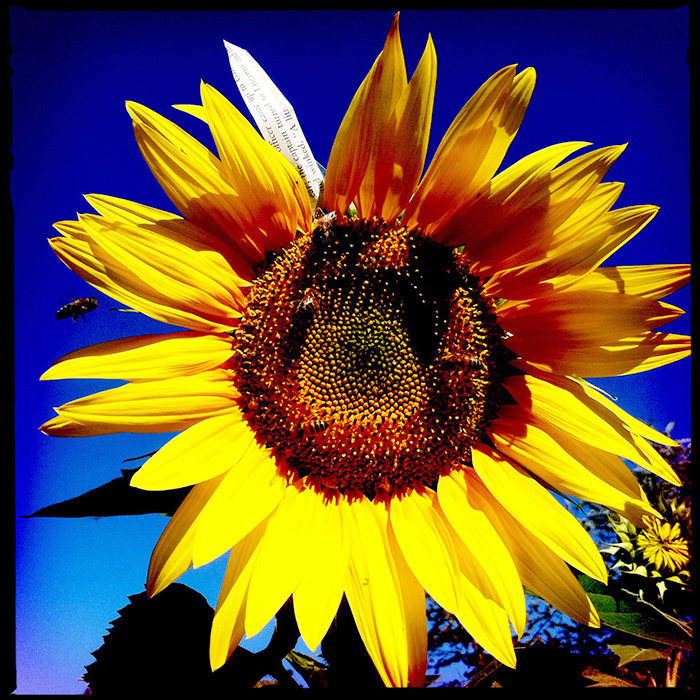
Rhonda Ayliffe – one sunflower with repaired/ replaced petal and some bees
Can permaculture be used as the philosophical foundation of an arts practice? This was a question I posed in my Higher Degree research project ‘codex infinitum – the infinite book’ that ostensibly investigated the future of books and knowledge in a digital world but incorporated permaculture ethics and principles to guide my studio operations. Permaculture has been used in organic horticulture, small and larger scale agriculture, in relocalisation movements such as Transition Towns, and by individuals seeking more sustainable and ecologically responsible lifestyles. What could permaculture offer to an individual art practice and what changes would the adoption of permaculture’s ethics and principles cause to art making became key questions I wanted to address within my research. My essay Permaculture in the practice is an informal account in part drawing on my MFA exegesis.
I was born, raised and remain in a small community on the far south coast of NSW. Generations of my family have occupied this same small territory, a tight 10km radius around the tiny township of Cobargo; traditional country of the Yuin people. For the past 25 years I’ve lived on my family’s 360 acre beef property at Sams Creek. I married the neighboring dairy farmer and his 800 acres, and inadvertently have found myself a custodian of a significant swathe of farmland nestled at the outer foothills of Gulaga, the mother mountain. The combined farms are bordered to the west by the Kooraban National Park, with its small and highly vulnerable yet genetically significant koala population, and they encompasses Sams Creek, a small waterway that eventually empties to the east into Wallaga Lake, Batemans Marine Park. The farms feature varied productive pasturelands, remnant temperate rainforest, woodland and indigenous grass species, vital bird and marsupial habitats and wildlife corridors. The combined farming properties are of cultural, historical, economic and environmental importance.

This is my place in the world. Connection to place informs every aspect of my creative practice. It was through this sensed connection to place that, two decades ago, I initially became interested in bioregionalism, place-based education, restoration landcare, and permaculture. In 2010, as I commenced my studio-based Master of Fine Arts and completed my Permaculture Design Certificate, I began to speculate about the possibilities of utilising permaculture as the philosophical or ethical basis of an arts practice. This speculation and investigation became an integral aspect of my recently completed higher degree research project: codex infinitum – the infinite book.
Permaculture (initially a contraction of the words ‘permanent’ and ‘agriculture’ but now more readily understood as ‘permanent-culture’) is a form of systems-thinking design that was developed in the 1970s by Australians Bill Mollison and David Holmgren. Initially applied principally to forms of organic farming and gardening, in recent years permaculture has been explored as a potential philosophical and practical model for business and economics,   Transitions Towns,  the reorganisation of politics and society, and a means for moving to a more sustainable lifestyle.  Permaculture grounds decisions on three primary ethics: ‘care for the earth, care for people, fair share’ and twelve principles.
Permaculture Ethics and Design Principles Poster
Permaculture Ethics and Principles poster from permacultureprinciples.com

These principles as proposed by David Holmgren in Permaculture – Principles and Pathways Beyond Sustainability and referred to in my research project are:
  1.  Observe and interact
  2. Catch and store energy
  3. Obtain a yield
  4. Apply self-regulation and accept feedback
  5. Use and value renewable resources and services
  6. Produce no waste
  7. Design from patterns to details
  8. Integrate rather than segregate
  9. Use small and slow solutions
  10. Use and value diversity
  11. Use edges and value the marginal
  12. Creatively use and respond to change
The ethics and principles are used together, along with concepts such as guilds, zones  and layers  to create an integrated, (w)holistic, ecologically sustainable system that is the cornerstone of permaculture design.
Permaculture, in its traditional, utilitarian form, has been used as a basis for ecological artworks including Nils Norman’s Edible Park,  Fritz Haeg’s variousEdible Estates,  and Artist as Family’s Food Forest, created as part of the Museum of Contemporary Art’s 2010 exhibition: Balance – Art for a New World. Numerous eco-artists, eco-arts groups/organisations and socially engaged art workers have created work that either consciously or casually relates to the permaculture model. Within my practice and research project I was interested in exploring permaculture not just as the basis of garden or ecological artwork but as a studio methodology and the philosophical foundation of an integrated, holistic, bioregional and permaculturally inclined combination of art, work and life.
Embarking on a life/practice change of this magnitude, the big question of course was ‘where do I start?’ I began with the completion of a Permaculture Design Certificate that empowered me to undertake both a range of practical projects around our 2 acre home/studio garden (this included retrofitting of solar panels, grey water system, reinvigoration of my extensive food gardens and orchard and the construction of an integrated studio/poultry house) and conduct an audit of all studio activities (including inputs, outputs, procedures and business activities).
The integrated studio and chicken housing at Sams Creek
Some of my earliest and simplest permaculture initiatives in the studio included a move to eschew toxic materials (in both art making and studio maintenance) and the composting/ recycling of studio ‘waste’. I have maintained an inter-disciplined or hybrid arts practice and my arts background is in the traditional crafts related to book arts – not the usual areas associated with an eco-art or socially-engaged practice. This presented unique challenges, but by building on simple, practical actions I gained the confidence to consider larger issues inherent in my arts practice that encouraged me to reflect critically on what I wanted  as an artist.
A project from 2011 signalled possibilities for an integrated holistic permacultural approach. In 2011 I became involved in the Kooraban koala survey and the Australian National University’s Eden Project Field Study program.  These two independent activities intertwined when I joined ANU field study participants on a koala survey plot near Dignams Creek and was invited to exhibit work in their group show Far Enough: Aesthetic responses to the Far South Coast NSW.  My corollary work, Kooraban Koalas, consisted of photographic documentation of a temporary artwork that acknowledged and commemorated the koala survey site close to my Sams Creek home. The work was displayed in the Bega Valley Regional Gallery along with a copy of ‘Koala Survey of the Kooraban and Gulaga National Parks’.
Rhonda Ayliffe – Kooraban Koalas, 2011
Kooraban Koalas represented more than just the exhibited photograph –it consisted of collective physical labour, empirical research, oral history, published and informal texts, along with site-specific art making. The multifaceted trans-disciplined work also exemplified a way of adopting and interpreting permaculture’s core ethics and principles within my arts practice.
I was buoyed by the potentials of an inter- or trans-disciplined approach experienced with Kooraban Koalas and how it signalled a manner in which permaculture could guide choices within my arts practice. For my MFA project I created honestum circuli – the virtuous circle – a small garden constructed from 217 discarded encyclopedias and based on a quintessential permaculture feature: the herb spiral.
Rhonda Ayliffe - honestum circuli, 2012
Rhonda Ayliffe – honestum circuli, 2012
Honestum circuli exists both as a semi-permanent structure in my studio garden and an accompanying artist’s book containing documentation of the garden’s construction, plant lists, plans and incidental notes.
honestum2
Rhonda Ayliffe – honestum circuli, 2012

Two other works from my MFA project signaled an alternative, indirect way of incorporating permaculture in my practice. Both codex inperfecto – the unfinished book, my long coptic bound ‘book’ structure, and carpe diem, an artist’s book resulting from my ‘art gesture’ series, epitomized how taking a permacultural perspective could influence my art making. The materials utilised in codex inperfecto (40+ volumes of unwanted encyclopaedias) represent a conscious move to ensure that my material choice and purchase proactively assists the environment while simultaneously helping to fund charity work.
codexinperfectodetail
Rhonda Ayliffe – codex inperfecto – the unfinished book (detail)
The books used in my work have been sourced from charity shops and book fairs (such as Lifeline, Rotary, Salvation Army and St Vincent de Paul) where they usually remained unsold and then required expensive disposal. My purchases ensured that the unsold undesirables were not sent to landfill while the purchase price actively assisted in funding each charity’s projects. This largely undisclosed social, economic and environmental cycle is an integral aspect of the work and an example of the holistic aspirations of my arts practice.
My ongoing ‘art gesture’ series  is a range of ephemeral artworks based on the interaction of books and site.
These interactions were informed by and created in response to the prevailing local conditions (seasonal change, weather, community and/or natural events) and actively embraced the smart phone and web as both the creative means and destination for the work.
artgesture1
Rhonda Ayliffe – one sunflower with repaired/ replaced petal and some bees

It was my observation that creating and distributing work online apparently circumvented some of the less sustainable aspects of the art business world. The combination of smart phone technology/photography and blogging may initially appear incongruous with a permacultural approach – so I usually clarify this by relating the provenance of my equipment and discuss appropriate technology choices as an active aspect of the work’s story. When provided with the opportunity I like to explain that I generally use second hand and discarded equipment – my computer(s) were rescued just before they were due to be binned at the local school and my smart phone is a clunky old model that’s still operating.
These recent works essentially chronicle the evolution of my methodology as I gradually embraced permaculture in my practice. In summary, utilising permaculture as the ethical/philosophical basis of my practice in practical terms has resulted in a move toward:
  •  using recycled, reclaimed waste product as my primary studio materials and in auxiliary arts business activities
  •  using local, homegrown or gathered ‘green’ art materials and associated methods wherever possible and appropriate.
  •  working ephemerally and recording ephemeral ‘art’ actions in a digital format for sharing digitally and/or online.
  •  avoiding air flight
  •  slow working, small working, humble working, performative working, collaborative and collective working.
I would note that my research project did not progress without difficulties and frustrations. Permaculture operates primarily outside both academia and the art world and the atypical combination of books/knowledge as the subject of my studio work and permaculture as methodology created unusual tension. I addressed part of this problem by looking at connections between pragmatic philosophy and permaculture in my MFA exegesis. Both permaculture and the pragmatic texts of John Dewey emphasised holistic and experiential learning/knowledge, intimate immersion in the environment and knowledge-building through practical application. Similarly, both Dewey and Holmgren reject notions of duality or dichotomy between nature and culture, mind and body, form and content as well as the idea of nature (and experience) as closed and static. The combination of pragmatism and permaculture offered a robust and logical foundation in which to explore the ideas about the site and construction of knowledge, the purpose and potential of art, research methodology and the holistic integration of art and life: the central motifs of my research project. As I noted in my MFA exegesis: permaculture provided both a way and a why for my arts practice.
With my MFA project now complete I am contemplating a more enthusiastic and comprehensive embrace of all things permacultural. Future trans-disciplined projects on the farm, in the garden and the studio include waterways restoration work and wildlife corridor construction in conjunction with Southern Rivers Catchment Management Authority  and the Biodiversity Fund , the establishment of Black Wattle Place Based Education hub sited on the farm, and contributing to the foundation of PIP – Australian Permaculture Magazine. I have commenced construction of stage 2 of the studio dye garden with the spring planting of calendula, woad, Japanese and Australian indigo and I’ve started researching/ experimenting with natural protein based (milk and egg) paint bases from our farm produce.
The adoption and application of permaculture’s ethics and principles within my practice is, and necessarily will remain, an ongoing activity and the creation of a perfected exemplar has not been my prime objective. Instead I am keen to promote the notion that it is possible to achieve positive change by incorporating permaculture within any arts practice and the best way to do this is to start small, build upon success, accept imperfections and adopt the maxim: ‘Start where you are. Use what you have. Do what you can.’ Permaculture in my practice means acknowledging that all the myriad aspects of my life and work are interconnected – so tending the garden, preserving the abundance, assisting a sick animal, remediating farmland, counting koala scat, working beside local school children, making ephemeral art, blogging or binding a book are ALL aspects of my intertwined, inter-disciplined, bioregional, permacultural arts practice.
“It is not the project but the living process that will be the measure of our actions.”              David Holmgren
Rhonda Ayliffe
Sams Creek, Cobargo NSW
November 2013.

Tuesday, December 24, 2013

'Perennial Symbols of the Botanical Realm I'


This artwork 'Perennial Symbols of the Botanical Realm I', 60 x 120 cm, was originally a Dyptich and began its life in the studio I occupied in Paddington in the second half of 2010. 


After a few days of working on this painting following Xmas, 2010 a full month of intense, drenching rains led to the first major flooding Brisbane had seen in decades. Although the studio was high up on a hilly ridge it was a bit wet when I returned to find how things were. All was fine though. During the flood I was forced to stay put at home in Clayfield. Roads had been cut off everywhere so it didn't even bear thinking about trying to get in to the studio to work. Most of Queensland had gone under water, flooding had devastated some areas and loss of life was serious.

As I'd grown up in a river town in Northern NSW flooding brought back stark memories. Summer was swallowed up by rains and grey skies and difficult stories of how it had been for others. This painting languished for a couple of weeks and I moved out of the studio soon after. It was months later I started work on it again... but in my small studio at home it was a bit crowded working on such a large canvas and I never was sure where this was going.


Getting started at the Paddington Studio... painting on the right
was a Dyptich that eventually evolved into something complete.


For ages there was something very heavy, very stuck 
 about this work ... I was unable to lighten it up in any way.


to say I worked and reworked this canvas is an understatement.

And yet...


... this other work in the blue green palette never presented 
that problem and instead, just came gradually to life! 


If you look at this section of the finished artwork below you'll note I was eventually able to find a way into this work but not before I took a paintbrush to it and radically altered it by whiting over areas of the painting in order to start building up colour dynamics and layers from scratch again.


This time around the eye had space to rest and areas of the work acted like pathways, breathing spaces between intense sections of colour and pattern.


Here is a small section which highlights the interplay of colour and form, patterns and motif.


Recently I put this work in my Online Shop as a print... making the image above this one available as an archival Limited Edition print. 

The original artwork was shown as two separate artworks at my February Exhibition and both works sold on Opening night which was interesting given I'd separated them. The owner of this work kindly indulged me when I decided I needed to tinker slightly with the work before she collected it after the exhibition was over. I'm very glad for that extra bit of time to add some layering after I'd had the chance during the exhibition to ponder the work. When I finally parted with it I felt it was fine... even if it took a little over two years.


Given that rather involved story its been interesting to find this work being chosen ( a section of the work that is) for use on a christmas card for an organisation based in Bonn, in Germany.

The organisation's agenda happens aligns surprisingly well with the artwork's essential message... referring as it does to the perpetual cycles of the Seed inheritance from around the globe, through layers and laters of small seed forms. 

The Global Crop Diversity Trust is 'an independent international organization working to guarantee the conservation of crop diversity. Forever.' 

This excerpt below is quoted directly from their page WHO ARE WE?

Crop diversity is one of the world’s least recognized but most valuable resources.  Individual crop varieties, such as the 200,000 varieties of wheat, have different traits for drought or heat tolerance, nutritional quality, disease resistance and every other possible characteristic. 
Crop diversity is therefore the raw material for improving and adapting crops to meet all future challenges.  Yet at the moment much of the world’s crop diversity is neither safely conserved, nor readily available to scientists and farmers who rely on it to safeguard agricultural productivity.  Diversity is being lost, and with it the biological basis of our food supply.
The Global Crop Diversity Trust is the only worldwide response to this funding crisis.  In a world where there are many important, and apparently overwhelming, issues demanding attention, it is important to note how the Trust differs from other organizations competing for donations
Its mission is achievable. It is rare that the world faces a major problem which has highly disturbing implications but an identifiable and achievable solution. This is preciselywhat the Trust offers; a costed, measurable plan, relying on existing institutions and simple proven technologies.
It is the only solution. Crop diversity is disappearing, and the Trust is the sole dedicated worldwide funding organization for its conservation. The Trust itself is operating in a unique political "window of opportunity", following the entering into force of the new International Treaty on Plant Genetic Resources, and has partnered with all the important organisations in this field. The Trust offers a unique opportunity to put in place a rational and cost-effective system for the conservation of the resources which underpin all agriculture and the world's future food supplies.


This is one of the organisations I began visiting online as I researched for the residency at Mt Coot-tha in 2010. Investigating Biodiversity initially was through the website of the UN International Year of Biodiversity in 2010 and also  Kew Gardens and the Millennium Seedbank. This had been a springboard to Bioversity International and the Global Crop Diversity Trust.

Hence, I've posted frequently here at this blog on these organisations. You might to read their website to consider the work being carried out in connection with numerous countries, organisations and individuals. My Scoop-it site Bio-cultural Diversity when I get time is one of the places where I get feeds from the Crop Trust. 

I've often rescooped posts by Luigi Guarino, senior scientist at the Crop Trust. Click to visit his sites.

Luigi Guarino

Luigi Guarino & Jeremy Cherfas discuss the diversity of crops, livestock, microbes and foodways at the Agricultural Biodiversity Weblog... and here.

I was contacted by Luis Salazar from Bonn who arranged for this Xmas card to feature my work and a follow up later in January with promo on the Homage to the Seed Project.


I'm very pleased to have been able to share this work with this very unique and fascinating Not-for-Profit organisation, especially knowing the enormous value  of the work they do and are connected with. I've often started my day trawling through sites like their website, Luigi's Scoops or similar. Before I'm up and into the day I've often spent two hours reading current news from around the world on seeds, biodiversity and so on. Its a pattern that has become somewhat fixed over several years now.

I used to trawl art and design websites most days when I could, and spend hours blogging per week. But as the climate shifts and life on this globe of ours is ever more pressured I find it is of utmost relevance to have a sense of where I am, and where we all are, through these stories. 

My language remains very visual although I'm prompter at times to need to write.  I paint for intense periods when I can. However, the painting is very often a meditation... a stilling of the mind as all the reading and thinking settles into a place where I can feel my response and make choices about how to proceed and think my way to the next thing.

Its late now but I did want to make this post tonight so I can share it as this year is winding down fast. My intern Jane, a 17 yr old student is coming in the morning. I haven't packed to go up the range on Boxing day for 5 days of painting in the Springbrook National Park. Xmas day I guess I can do that. 

This painting of Perennial Symbols which started in the big rains of late 2010 into 2011 is alive and well in spirit. Now more than ever it seems we must find ways to celebrate our natural heritage and care for it. Our way may not be the same as another's. And perhaps conversations are a really good starting point.

During the last five years of this project on seeds I've had to deal with moments of interrogation or angry monologues from the odd person who needed to point out to me that Scientists were evil and why was I working with them ... and Seed banks were very evil. At first I wondered what they knew that I didn't. I was prepared to admit my knowledge was poor. In the end I realised that if it wasn't a two way, mutual conversation they maybe didn't know terribly much ...  but neither did they seem to have the desire to be open or learn either.

Don't forget ... you can enter my intern Sam's Competition Survey. I will draw the winner on my return at New years... so get your answers in! Its the previous post where she wrote about entering the survey.

Best wishes to all for a very peaceful festive season, wherever you are.

Sophie


Thursday, December 19, 2013

Be in the running to win a PRIZE ... FILL OUT OUR SURVEY!


Hi all, 

My name is Sam and I am currently  doing an internship with Sophie on her Homage to the Seed project. Last week was my first time working at the Seed Art Lab. I wrote a blog post about my art while I was there. 

So I'm back again to talk about an idea that Sophie for us to conduct an interesting survey on seeds. 

We wanted to test people's awareness of seeds. 

All you have to do is answer these questions and be in the running for some of Sophie's post cards and another prize.  (original Sophie Munns artwork) The purpose of this survey is to see how differently adults and people around my age (15) respond to this. 

Hope to hear from you 


If you can send us an email with your answers here  we will be sending out a postcard to the first 5 responses and the best response of all will receive an original artwork like this example from a recent series of watercolours: 


Message from sophie:  this page at my Seed.Art.Lab where I have this series of artworks for sale. The prize will be one of these artworks that is available.

"50 Watercolour paintings"  A series of works on 300gm Cotton paper, 10 cm x 21 cm. Some in the series of 50 are now sold. If you are interested in these I can send images via email.
$75 each or series of 3 for $180.
MORE INFO and background story in the Blog Post.

Looking forward to hearing from you everyone!

Saturday, November 16, 2013

7 days till the Studio: Seed.Art.Lab Launch

7 days till the Studio: Seed.Art.Lab Launch

I've shared this post directly from my Studio Archive blog as its a hugely busy week and I wanted to be sure to keep you informed in case you are in these parts next weekend and can attend the Studio Launch!


This lovely new glass cabinet has pride of place in the new studio...


more on this below...


Recently I was part of a Artist-in-residence program that brought  5 artists together to work with the Jump-start Program at Kelvin Grove Secondary College in Brisbane.


I wrote about it at the Homage to the Seed blog and he ought I'd post here something I wrote for the exhibition which started with the quoted above from Tom Waits from an interview with him in 2006.

This project really prompted me to think very deeply about the children inheriting this planet now and the silence of too many adults around the state of the planet. It must leave them asking a lot of questions quietly to themselves late at night if not elsewhere in their lives.

This is then what I wrote.


ITS GETTING HOT AROUND HERE : The Seeds and Bio-diversity story. 

Artist Statement from Sophie Munns 


In the 21st Century no longer can we take for granted continuation of life for thousands of plant species... including some of the 30,000 known edible species and countless other highly useful species we rely on. In fact we don't even know what remarkable seeds might be lost to us given that scientists are still discovering species, particularly in fragile Rainforest eco-systems. Certain plants have long been commodified for use as fuels, glues, plastics, fibres, textiles, papers, rubber, building materials, medications (traditional to bio-molecular), beverages... and the list goes on. 

Chocolate and coffee lovers around the planet are waking up to the rude fact that their favourite of tropical crops does not like it getting hotter. This has demanded swift response from plant science, farmers and a growing sector of coffee and chocolate companies to shift focus from quick-growth profit margins to the crucial step of increasing sustainability in the way coffee and cacao crops are grown, delivered to market, and understood by the public... all in the effort to ensure these potentially endangered species are maintained for the long term. This story is repeated over and over with many other species we like to put on our tables. 
Seed viability, the capacity of seeds to produce new life, is indeed a concern not always understood. Artist Residencies undertaken by Sophie Munns in Seed Bank Labs and Botanic Gardens since 2010 have led to ongoing exchanges with plant scientists, with access to an expanding field of scientific knowledge revealing precisely how changes in climate go on to impact the capacity of plants to survive in particular locations that for hundreds, even thousands of years, saw plants prosper in those very same regions. 
All around the globe the up-scaling of research on complex impacts on plants and eco-systems is bringing out a plethora of profoundly significant material that rarely reaches a general public audience. Dispersing information to the broader public has become an increasingly important task for the Science community and all who recognise the difference quality education makes. This is without doubt a potent and invaluable role the Arts can play in aiding the communication of critical material to a wider audience. 
Bringing ‘Seeds and Biodiversity’ to the Jump Start project the artist spent 4 sessions with a group of students examining key issues around Seeds and Biodiversity informed by current global research across Plant Science, Agriculture and related social, political and cultural issues. Students were given an overview of the role seeds have played across time, going back to the earliest known civilisations. We explored the cultural heritages of each individual in our group ... noting, wherever possible, links to family and ancestors from all over the globe and the unique relationship to plants and food growing they may have had or perhaps still have. We thought about how this shaped the cuisines and traditions we may have inherited or perhaps have some inkling of. 
Also discussed was the extraordinary number of ways that humans work with seeds and plant material, use them for hobbies and leisure, or pursuits with artistic or cultural purpose. Crucially, we considered why seeds need our protection right now in order to ensure our own well-being into the future. 
For inspiration the artist brought examples of her artwork, seed collections and items made from seed and plant material. Additionally we explored with work of two key artists ... Brisbane painter Robert McPherson’s series of bold graphic painted signage in large wall installations provided an ideal visual strategy and NY artist Keith Haring who rose to prominence in the 80’s for his strong grafitti style and extraordinary 'symbol + text' images. 
The graphic work exhibited here may at first glance appear simple, even unsophisticated. Look further at the ideas and thoughts being expressed and a potent truth may be revealed. These year 7 students are emerging into a very different world than the one familiar to those currently in the driving seats of our communities, organisations and institutions. Thoughtful students can often see a different world to the one their elders see. They possess enthusiasm for wide-ranging questions given the opportunity, and its evident they may not think it’s smart leaving nature and the environment out of planning strategies and decision-making. A desire to discover more on the complex, often contradictory aspects of how our world is evolving is heightened wherever interest in ideas, research and sharing of thoughts is encouraged. 
Given the young are inheriting a world slow to learn or act on changes already proven necessary its crucial they be able to explore and evaluate ideas and information. The case of Tobacco companies maintaining the fight to exist in the market-place despite conclusive medical science research and Govt public health campaigns demonstrate s clearly that where economics is concerned its up to each of us to question what the ads and headlines are telling us! Education has never been more vital if we want young people to be informed in taking on the challenge of climate change and the increasing call for sustainable practices that are effective, pragmatic and life-preserving. 
The capacity to think creatively, to bring both passion and critical thinking to the finding of new solutions is championed in this program which recognises our future is here... that the thinkers and creators of the future are here in this room tonight! 
Bravo to all the students taking part in JumpstART! 
Sophie Munns wishes to thank the excellent JumpstART team for this unique and highly stimulating opportunity to engage with these young thinkers and creators before us. Their insights and efforts to navigate the changing conditions of this planet demand our encouragement, sustained interest and respect as we all learn what it means to tread more carefully around this home we all share. 


I've returned over the years many times to working with children of all ages for one reason or another. Teaching posts and substitute teaching for one, then there have been classes given due to requests from parents for quality lessons not so easy to come by these days.

Recently I had two very alert students come for a 4.5 hr intensive in the holidays .... drawing and thinking about plant science. This is the direction I intend to keep on with... small groups sessions with people of all ages, focused on seeds and biodiversity and ways to think and interpret this material visually.


More on that soon. For  now I am delighted to share a small image of my new glass cabinet for seed collections taking pride of place in the new studio.


Its a beauty! Even the colour I love.


And a reminder that if in this part of the world you are welcome to come along to the launch next weekend... contact me if you need to find out more.


Busy times... back soon. Go well everyone!

Related Posts Plugin for WordPress, Blogger...