Showing posts with label museum. Show all posts

Saturday, July 16, 2011

Planning to visit some interesting places in a few months!


I had to post on this as I am going to have a chance to go visit all kinds of fascinating places in London this October.... and this is one place I hope to get to... very close by the Victoria and Albert Museum.


You can read much more by visiting the website and seeing what's possible to view online as well as onsite. Botany is one of the departments with a large collection and research being carried out. Of course I had to see what this was all about. Click on the green text below to read more under each title.

Seed plants (spermatophytes)

What are seed plants?

Seed plants are characterised by the development of a seed after fertilisation. The seed usually contains an embryo and a food supply, all surrounded by a protective coat.
  • Dried specimen of the common poppy, Papaver rhoeas L, from the Museum's herbarium
    Groups
    Find out about the two major groups of seed plants: angiosperms and gymnosperms.
  • Wood anemone, Anemone nemorosa,  growing in woodland
    Habitats
    Learn more about the abundance and habitats of angiosperms and gymnosperms.
  • Fossil of a wind-dispersed seed of Acer pseudocampestre
    Evolution of seed plants
    When did seed plants evolve?
  • A scanning electron microscope image of a blueberry (Vaccinium sp.)
    The impact of seed plants on our lives
    Seed plants play a host of important roles in our lives, from providing food to controlling pollution, but can also cause problems such as hayfever.
  • Solanum herculeum, a narrow endemic from southern Spain
    Seed plant research
    Seed plant taxonomic expertise within the Botany Department includes the Asteraceae, Convolvulaceae, Hypericaceae, Orobanchaceae, Solanaceae and Urticaceae families. Find out more about related research projects.
  • Anemone pavonina, a flowering Mediterranean plant species
    Seed plant collections
    Find out about our seed plant collections, an important resource for the scientific community. The earliest specimens originate from the 17th century and some collections provide time series that make it possible to study climate and vegetation changes.


    View of the Museum from the Wildlife Garden
    View of the Museum from the Wildlife Garden

    Opening hours

    The Botany Department is open to visitors Monday to Friday (except Bank Holidays) from 9.00 to 17.30 or by special arrangement. Please contact us first by phone or email to arrange your visit.


    Sister institutes

    The Department of Botany at the Natural History Museum holds national and international collections. Equivalent organisations in the UK are the Royal Botanic Gardens Kew and the Royal Botanic Garden Edinburgh. We have strong links with both.
    We also have links with the Museum National d’Histoire Naturelle in Paris, exchanging staff and ideas. We collaborate with other botanical institutes and laboratories around the world.
    Unlike the Royal Botanical Gardens at Kew and Edinburgh, the Natural History Museum does not maintain its own botanical garden. Some studies are carried out in our Wildlife Garden but our living collections are held at the Chelsea Physic Garden.
    For details on how to contact us go to departmental information.


    Welcome to Chelsea Physic Garden

    Situated in the heart of London, this 'Secret Garden' is a centre of education, beauty and relaxation. Chelsea Physic Garden was founded by the Worshipful Society of Apothecaries of London in 1673 for its apprentices to study the medicinal qualities of plants. Throughout the 1700s it was one of the most important centres of botany and plant exchange in the world. It is London’s oldest botanic garden and a unique living museum.
    Late night openings 2011From 29th June to 7th September the Garden will be open until 10pm on Wednesday evenings (Last entry 8:30pm). These late openings go hand in hand with our Summer Evening Talks which this year are based on Trees.
    For the full list of Tree talks click here.

    TREES - Summer Evening Talks - 29th June - 31st August
    Over 100 different named trees grow at Chelsea Physic Garden, from pomegranates and cork trees to grapefruits and olives, cedars and pines to mulberries, magnolias and eucalyptus. The Garden probably has the greatest variety of living trees in one place in central London. Many are rare in Britain...and every one of them has a story.
    As part of the UN International Year of Forests, Chelsea Physic Garden celebrates trees: their origins, anatomy, uses and mythologies and trees will be the special theme for the Garden's 2011 summer evening talks.
    Hugh Johnson, well known for his wine books and also an authority on trees, will kick off the TREES season with a fascinating look at exotic trees in the English landscape.
    Summer Talks tickets are £15 (including Garden admission)/£10 for Friends of the Garden.
    For full programme details please click here.


    The Chelsea Physic Garden has developed a major role in public education focusing on the renewed interest in natural medicine. The Garden of World Medicine which is Britain's first garden of ethnobotany (or the study of the botany of different ethnic groups and indigenous peoples) is laid out together with a new Pharmaceutical Garden.
    More history of the Garden can be found on the page about the Historical Walk, as well as the following links:

    Union Jack flagChelsea Physic Garden - A Brief History (PDF/484Kb)


    Picture of Hans Sloane's statue through a plant bed


    How charming..... there is a cafe there called " Tangerine Dream Cafe" and they serve things like


    Fig, thyme and almond tart*

    Tunisian citrus almond cake*
    Lemon tart*
    Lavender scones with clotted cream and homemade seasonal jam
    Fabulous brownies*
    *All served with creme fraiche where desired
    RefreshmentsPots of Tea
    Real coffee, espresso, cappucino
    Homemade lemonade
    Homemade ginger beer
    Real ale and lager

    I am going to be very busy getting around I can see...so much to see...  
    if only I could make it to Paris....


     from France... these looked so interesting...
    Les collections de végétaux vasculaires sont très importantes au Muséum, au sein de l'imposant herbier national mais aussi sous forme de collections vivantes, dans les serres et les jardins. Les végétaux vasculaires, rassemblant les plantes à graines et les fougères, possèdent racines, tiges, feuilles, et vaisseaux permettant la circulation de la sève entre les racines et les parties aériennes.






Monday, April 18, 2011

Paolo Viscardi: Natural history collections - why are they relevant?

Last week I found this article through twitter that I thought was very worthwhile... so I tweeted writer Paolo Viscardi to check if I could reblog it here.

Thank you Paolo for willingness to share!  If you pop over to the original article you can view two videos included in the piece!

Lately I've come across related reports on the critical role Museums can play, despite the fact from time to time they attract attention for controversial reasons...so here's some positive food for thought!

Punctuated Equilibrium by GrrlScientist

Natural history collections –- why are they relevant?

A curator at the Horniman Museum tells us why natural history collections are important to research -- and to the public
Natural history room of the Horniman Museum.
Image: Wikipedia commons/Simon and Ashley.
I'd like to start by thanking GrrlScientist for inviting me to set out my thoughts on the relevance of natural history collections here at Punctuated Equilibrium – it's an honour.
The subject is one that's close to my heart -- I'm a natural history curator, a member of the Natural Science Collections Association committee, a natural history blogger and an administrator for Ask a Biologist (amongst other things). I view natural history collections as being very important and I want to provide some of the reasons why.
Museums in the UK
Let's start with some context. Few people would argue that museums in general are unpopular –- last year there were over 42 million visits to DCMS (Department for Culture Media and Sport) sponsored museums alone. When you factor in the Local Authority museums and independents you're looking at a substantial proportion of theUK's population of 62 million people attending museums.
But these visitors are mostly seeing the tip of a very large iceberg, since the vast proportion of most museum collections (90-99%) is in storage. But that doesn't mean that the majority of collections aren't used. Far from it. Museum collections are used for all sorts of things, from filling in gaps in family trees and inspiring art (some of which is frankly nombrilistic) to research that is of value to wider culture and science.
The role of natural history
Apart from being hugely popular with the public, natural history collections play a vital role in our understanding of biodiversity, evolution, population genetics and the environmental impacts of climate change, pesticide use and so on. This is because historical collections provide base-line data against which modern observations can be compared and to produce predictive models.
The most fundamental role of natural history collections is safeguarding type specimens. These are preserved specimens of the individuals that were used to describe and name a species. Every plant, fungus and animal you see in your garden has a scientific name that comes from such a description and each new proposed species needs to be compared to the preserved types of other similar organisms in order to ensure that it is in fact different to anything already described.
Obviously the life in your back garden is pretty well known by now, but there are still parts of the Earth that have not been thoroughly investigated and new species are coming to light all the time –- particularly in the oceans and tropical forests.
Beyond the important type specimens, museums also hold voucher specimens [pdf], which are examples of organisms collected during biological recording and other research. These specimens are physical proof that work has been conducted and that species have been described accurately. Most importantly, they have good information about where and when the specimens were collected.
The value of specimens
Every natural history specimen with good data provides a physical snapshot of a species or community at a particular point in time and space. It is this physical record that makes museum collections so valuable –- you can't extract DNA from a photograph and you can't test a written description for pesticide residues, but a physical specimen can provide a wealth of unexpected information.
Specimens collected before DNA was even known are now able to provide information about how populations have changed over time and how that might influence conservation of threatened species. This kind of study is of particular interest where populations have suffered dramatic decline and face genetic bottlenecks, as with several beleaguered bird species from New Zealand [link opens pdf] and tumorous Tasmanian Devil.
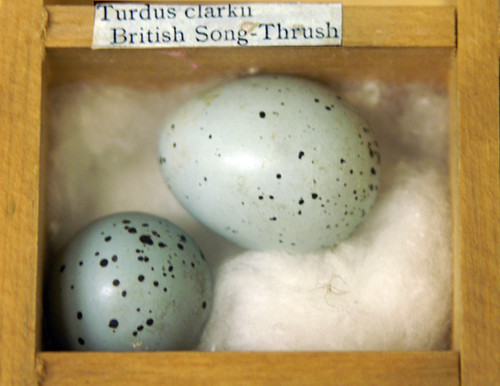
But it's not just preserved DNA that can be useful. Much of the research that led to tighter controls on pesticide use in agriculture (including the banning of DDT) came about by comparing the thickness of eggshells in museum collections from the 19th-20th Centuries [pdf review and related research on British Thrush eggs].
Challenges facing natural history collections
For research to be possible, museums need to be able to care for their collections and make the associated information as accessible as possible to researchers. The Internet provides a fantastic medium for access, but unfortunately many museums are struggling to get information onto databases due to the volume of data and lack of staff.
The museum sector is undergoing a period of substantial change in which priorities and models of work are being reassessed in light of funding cuts. Social Enterprise has been embraced by some museums [pdf] and may provide some good opportunities, particularly if the development of partnerships can increase collections access. However, change also brings the potential for considerable threats, particularly if focus shifts away from long-term collections care, access and development. An additional danger, particularly for hard-hit regional museums, may be the loss of the specialist staff needed to identify appropriate partners and develop the relationships needed to survive the uncertain times ahead.
Natural history collections are demonstrably important –- not just for education and cultural reasons, but for wider environmental reasons too. If we want to maintain our biodiversity and understand changes in our environment we need to sustain our natural history collections. In the words of Suarez & Tsutsui, 2004:
Nothing will ever replace the taxonomic knowledge and training that museums provide; funding in this area should become a national priority. Otherwise, knowledge of this planet's biodiversity, and of all the potential benefits therein, will be lost.
.
Paolo Viscardi is the deputy keeper of natural history at the Horniman Museum in the Forest Hill area of London. He is also involved with science outreach through theAsk a Biologist website and he writes the excellent blog, Zygoma.

Related Posts Plugin for WordPress, Blogger...