Showing posts with label United Nations. Show all posts

Wednesday, March 23, 2011

WORLD WATER DAY!


Homage to the Seed pays tribute today to water... something so essential to life on this planet!


sophie munns
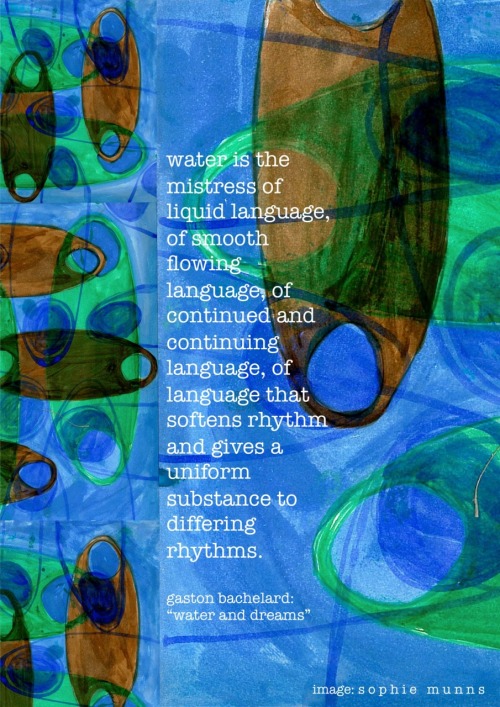
For a number of years my artwork explored water and fluidity... an incredibly rich area
for exploration ... this image is posted here at Seed Capsules.


March 22nd has been chosen to celebrate the UN World Water Day 2011
... links to the UN site here.

This is the first time in human history that most of the world's population live in cities: 3.3 billion people ...and the urban landscape continues to grow.


38% of the growth is represented by expanding slums, while the city populations are increasing faster than city infrastructure can adapt.

The objective of World Water Day 2011 is to focus international attention on the impact of rapid urban population growth, industrialization and uncertainties caused by climate change, conflicts and natural disasters on urban water systems. 

This year theme, Water for cities: responding to the urban challenge, aims to spotlight and encourage governments, organizations, communities, and individuals to actively engage in addressing the challenges of urban water management.

You'll find much more at the Un website link above.

I also want to link you to Robyn at her wonderful blog: "fragments  treasures  memory" where she celebrates this important day with a wonderful post & excellent links ... you can visit here
Robyn is one of those animated individuals who makes a point of getting dialogue going through her blog to prompt stronger connections to what is important on this planet. Passion with equal measure equanimity and warmth ... its always a pleasure to visit Perth-based Robyn. Do visit and say I  sent you along!


image found through Seed capsules


vapours:

by Louisiana Mei Gelpi
for an interesting read:  Salina Art Cemtre in the US is putting this event on later this year....looks fascinating...  love to be involved in something like this!


July 08, 2011 — June 17, 2012

Streams of Consciousness: The Histories, Mythologies, and Ecologies of Water

Recalling the Latin phrase Sine Qua Non (Without Which Nothing), the investigation of the nature of water and its relationship to humankind is a timely journey of beginnings, transformations, and critical necessities. Being one of the planet’s most vital natural resources, water is essential for life, embodying the chance of life or death in every drop. In all its forms—gas, liquid, solid—water permeates the fiber of every living being on earth and often goes unacknowledged until rivers run dry or bodies grow parched. 
Many of today’s artists are sensitive to water’s significant and complex role on earth. Through a broad range of perspectives and artistic practices, these artists brave the ambiguous tides and unknown depths to tap water’s myriad meanings and associations. Whether responding to the fantastical tales of seafaring pirates or the privatization of freshwater, artists gaze toward a watery horizon for discoveries and understanding of how water informs contemporary culture.
The Salina Art Center’s forthcoming exhibition approaches the topic of water on macro and micro, local and global scales. Including national and international artists and artist groups, the exhibition will unfold in three “waves” over the course of one year, providing ample time to fully plumb this seemingly boundless subject.  While conceptually organized into three distinct waves,—histories, mythologies, and ecologies—the physical manifestation of the exhibition and the related public programs will reflect the organic nature of water: diverse ideas, perspectives, and conversations will amorphously flow throughout this open-ended system of experimentation and discovery.

CURRENTS: Community Conversations about Water
In preparation for Streams of Consciousness, the Salina Art Center will host a series of public forums to establish a critical, community-wide discourse about the topic of water. Free and open to all, these focused conversations will be facilitated by the Swim Team—a group of area water specialists—and visiting artists researching water issues in Kansas.

Read more here!


Friday, January 21, 2011

2011: UN International year of the Forests - what can we bring to this year?


There are many ways to contribute in this world!


Whilst visiting Robyn at Fragments, treasures and memories I discovered her post with this wonderful video:   MUSIC PAINTING - Glocal Sound - Matteo Negrin
A gentle approach to Global Warming.

Robyn writes "we are eco-system destroyers and we need to change our ways."
She is based in Perth, Western Australia is both direct and no-nonsense and remarkably warm and caring... with a loyal blog following who relish her desire to speak straight from the heart on what matters most in daily life.

Many times Robyn has sent me things to post on the Homage blog... so dod pop over and see whats happening in her corner of the world!


....and talking about contributing... a visit to the UN website for this years theme offers many ideas for your consideration.

After the global focus on Biodiversity last year this year the UN is celebrating the International Year of Forests - 2011.

logoslogos
Logo for 2011


The International Year of Forests 2011 (Forests 2011) logo is designed to convey the theme of “Forests for People” celebrating the central role of people in the sustainable management, conservation and sustainable development of our world’s forests. The iconographic elements in the design depict some of the multiple values of forests and the need for a 360‐degree perspective: forests provide shelter to people and habitat to biodiversity; are a source of food, medicine and clean water; and play a vital role in maintaining a stable global climate and environment. All of these elements taken together reinforce the message that forests are vital to the survival and well being of people everywhere, all 7 billion of us.

Resolution adopted by the General Assembly

On the report of the Second Committee (A/61/422/Add.1 and Corr.1)

61/193. International Year of Forests, 2011


The General Assembly,

Reaffirming its commitment to the Non-legally Binding Authoritative Statement of Principles for a Global Consensus on the Management, Conservation and Sustainable Development of All Types of Forests and Agenda 21, adopted at the United Nations Conference on Environment and Development, the United Nations Millennium Declaration, adopted at the Millennium Summit in 2000, the Johannesburg Declaration on Sustainable Development and the Plan of Implementation of the World Summit on Sustainable Development, adopted at the World Summit on Sustainable Development, held in Johannesburg, South Africa, in 2002,

Recalling the Convention on Biological Diversity, the United Nations Framework Convention on Climate Change, the United Nations Convention to Combat Desertification in Those Countries Experiencing Serious Drought and/or Desertification, Particularly in Africa, and other relevant conventions dealing with the complexity of forest issues,

Recognizing that forests and sustainable forest management can contribute significantly to sustainable development, poverty eradication and the achievement of internationally agreed development goals, including the Millennium Development Goals,

Recalling Economic and Social Council decision 2006/230 of 24 July 2006,

Emphasizing the need for sustainable management of all types of forests, including fragile forest ecosystems,

Convinced that concerted efforts should focus on raising awareness at all levels to strengthen the sustainable management, conservation and sustainable development of all types of forests for the benefit of current and future generations,

1. Decides to declare 2011 the International Year of Forests;

2. Requests the secretariat of the United Nations Forum on Forests of the Department of Economic and Social Affairs of the Secretariat, to serve as the focal point for the implementation of the Year, in collaboration with Governments, the Collaborative Partnership on Forests and international, regional and subregional organizations and processes as well as relevant major groups;

3. Invites, in particular, the Food and Agriculture Organization of the United Nations, as the Chair of the Collaborative Partnership on Forests, within its mandate, to support the implementation of the Year;

4. Calls upon Governments, relevant regional and international organizations, and major groups to support activities related to the Year, inter alia, through voluntary contributions, and to link their relevant activities to the Year;

5. Encourages voluntary partnerships among Member States, international organizations and major groups to facilitate and promote activities related to the Year at the local and national levels, including by creating national committees or designating focal points in their respective countries;

6. Requests the Secretary-General to report to the General Assembly at its sixty-fourth session on the state of preparations for the Year.
83rd plenary meeting
20 December 2006 

Marking World Environment Day, UN sounds alarm on biodiversity (click on heading to read this article)


so what will we bring to this year?

Thursday, November 11, 2010

Biodiversity is life, Biodiversity is our life

alt

If you visit the website of the United Nations International year of Biodiversity you will find excellent resources available to learn more precisely:


  • The important role biodiversity plays in our lives and what is happening to it.
  • What people are doing around the world to combat biodiversity loss
  • How people are celebrating the International Year of Biodiversity
  • Some of the resources available to you in your celebrations

Read here for that.

If you go to this page of the website here you can see Homage to the Seed blog is listed along with a host of other blogs including one based in Byron Bay...not far from Brisbane where this blog is based.


Blogs from around the world

Lights of AfricaAfrica (English)
Lights of Africa - A Media Expedition Through Africa
By Haroldo Castro, an award-winning video director and producer, a photographer, a journalist and a communications strategist, and Mikael Castro, an anthropologist, communicator, and ecotourism-expert, passionate for conservation and travel.
ViajologiaAfrica (português)
Viajologia - Viajando com Haroldo Castro
Haroldo Castro possui três paixões: contar estórias com fotos e crônicas, estar na natureza e viajar intensamente.
Australia (English)
homage to the seed – generator of life
By Sophie Munns.
Guz Leonisky’s BlogAustralia (English)
It’s our ethical duty to stop our destruction of species. – BIODIVERSITY IS OUR RESPONSIBILITY 
Tangle of LifeAutralia (English)
Tangle of Life
By Mary Gardner, a biologist and a writer, she teaches at a local community college in Byron Bay, Australia. This blog is to help raise awareness about concepts and issues in biodiversity.
The blog uses social media and online discussions in getting the message out about the wealth of the world in the kingdoms of life. The blog features introductory articles, photos and links to showcase each kingdom. Also, Ebooks, with over 80 stories and over 300 photos, help readers glimpse biodiversity as a whole. .
Desarrollo rural lanzarote BlogCanary Islands (español)
Desarrollo rural lanzarote Blog
Por el desarrollo sostenible de los pueblos
New England AquariumKiribati and Phoenix Islands Blog (English)
Blog written by the New England Aquarium
Les ciències en el brochSpain (español)
Les ciències en el broch
By Ignasi Nebort & Pilar Safont
Window to NatureSri Lanka (English)
Window to Nature – The Weekly Environmental Diary by Malaka Rodrigo
Eco QuestionThailand (English)
Eco Question - Green Space for Thinking
Natures WhispersUnited Kingdom (English)
Natures Whispers
By Jasmine
Abstract City BlogUSA (English)
Abstract City Blog - NYTimes.com
By Christoph Niemann
The WILD Foundation BlogUSA (English)
The WILD Foundation - "Talking" Wild
The i2P Amazon Expedition
The i2P Amazon Expedition team is assembling to depart for Brazil. There are 108 schools in six countries and a total of 15,266 students registered to follow the expedition!
The Edmonton and Area Land Trust
A conservancy focused on protecting natural areas and landscapes in our boreal/parkland region, for their biodiversity, habitat, health, EGS, aesthetic and other values.


Obviously there's room for more if you know of a Blog that could be added!

United Nations Environment ProgrammeUnited NationsConvention on Biological Diversity


Apologies for the space that can't be shifted below. Scroll down to continue to next post.
Thank you,
Sophie

Friday, November 5, 2010

sovereignty


Western Australian based Robyn from fragments treasures memory weblog sent a video fro me to watch this morning that had references to grave consequences for seeds called "What in the world are they spraying?" discussing Chem trails (chemical trails). I then visited civileats.com a website/blog to see if there was anything coming up there on this geo-engineering. 

Civil Eats "promotes critical thought about sustainable agriculture and food systems as part of building economically and socially just communities. In our efforts, we support the development of a dialog among local and national leaders about the American food system, and its effects abroad. Civil Eats  style of conversation is as diverse as its 40+ contributors."

What I did find were recent stories on Food Sovereignty ( the video connected to this very much) which is what I have posted on today. Thank you Robyn for sharing something important to find out more about... and for prompting me to consider 

sovereignty |ˈsäv(ə)rəntē|noun ( pl. -ties)supreme power or authority how can we hope to wrest sovereignty away from the oligarchy and back to the people?• the authority of a state to govern itself or another state national sovereignty.See note at jurisdiction .• a self-governing state.ORIGIN late Middle English : from Old French sovereinete, from soverain (see sovereign ). 
 
The more I read about the world's traded seeds the less control ordinary people may have now over the right to access the seed heritage of the land they live in .... this is indeed a serious issue in some parts of the world and is worth being vigilant about. There are places it has become illegal to save seeds. If you have not been aware of this shift in circumstance over the last decade or so then it might well seem impossible to believe.

With thoughts of     s o v e r e i g n i t y   in mind consider these stories below if you have time to read them... 


2009, Paraguay


from the Women Seed Forum in South Korea
Content: This booklet is the compilation of the pepers and experiences of the women peasants from peasant organizations members of La Via Campesina in the region. The booklet explained about the role of the women peasant in conserve the seed and in another hand we are loosing the native seed we have. This booklet also given example how women peasant save the seed and exchange the seed among the peasant.

Rome, 14th October, 2010
U.N. COMMITTEE ON WORLD FOOD SECURITY

Farmers' evaluation of the UN Committee on World Food Security
Farmers from the international peasant movement La Via Campesina participating in the the plenary session of the Committee on World Food Security (CFS) of the UN in Rome (October 11-16) will present their evaluation of the discussion during a press conference tomorrow.
15th of October – 10h30: Press Conference by La Via Campesina
FAO, Via delle Terme di Caracalla)
READ MORE...
 
La Via Campesina Call to Action – Help Stop Terminator’s Return!
WEDNESDAY, 28 JULY 2010 17:01
AddThis Social Bookmark Button
(July 2010) Four years after the moratorium on Terminator technology was reaffirmed by the United Nations Convention on Biological Diversity (CBD), proposals to develop and commercialize ‘genetic-use restriction technologies’ (GURTs) are back on the agenda for policymakers and the biotechnology industry. Terminator is a threat to food sovereignty and agrobiodiversity: ending the moratorium on Terminator will increase control of seed by transnational corporations (TNCs) and restrictions on farmers’ rights to save and plant harvested seed. Additionally, pollen from genetically-modified (GM) crops with Terminator will contaminate non-GM and organic crops, and native plant species.
GURTs (herein referred to as ‘Terminator’) are genetic engineering technologies that seek to control plant fertility. First-generation Terminator (also called ‘suicide seed’) was developedjointly by the US Department of Agriculture and Delta and Pine Land Company in the 1990s to protect the intellectual property of US agricultural biotechnology TNCs. GM crops produce sterile seeds to prevent farmers from replanting harvested seed with patented DNA. Due to international public outcry from farmers and civil society worldwide, Terminator has never been commercialized anywhere, and Brazil and India have national moratoriums prohibiting it. In 2000, the CBD recommended a de facto moratorium on field-testing and commercial sale of Terminator seeds. In 2006, pressure from La Via Campesina and its allies helped to strengthen this moratorium in Curitiba, Brazil.
That year, US-based TNC Monsanto Company, the largest seed company in the world, acquired Delta and Pine Land, along with the intellectual property rights to Terminator. Since then industry, the US and European governments and ultra-rich philanthro-capitalists have ramped up rhetoric on the need for Terminator and other biotechnologies to adapt to the climate, energy and food crises. Various false solutions are being proposed to sell the lie that techno-fixes allow rich countries to continue consuming resources and emitting carbon dioxide, unabated: GM crops for cellulosic and second-generation agrofuels; geoengineering ‘climate ready’ GM crops and trees with increased albedo (reflectivity) and resistance to drought, heat and salt; monoculture plantation forests of GM trees to industrially produce biochar for carbon sequestration; and GM algae and marine microbes for carbon dioxide sequestration. Monsanto is proposing that monoculture plantations of its Roundup Ready soybeans qualify for carbon credits under so-called “no-till” agriculture. All of these false solutions create new markets for agricultural biotechnology and ‘extreme genetic engineering’.
With financing by the US government and British Petroleum (BP), in May, Synthetic Genomics, the company founded J. Craig Venter (which helped to sequence the human genome)announced that it had created the first-ever synthetic, self-reproducing microbe with synthetic biology. Venter’s team claims that the microbe can be used to produce clean, green algal biofuels; however, what will happen if this microbe escapes into the wild and contaminates non-synthetic algae with its DNA? Similarly, what will happen when a GM maize variety engineered to have a high amount of stover (the stalks, husks, etc. of maize) for cellulosic agrofuels contaminates food maize varieties? The implications are frightening. Industry is now claiming that Terminator is needed to contain genetic contamination (transgene flow) of food crops and other natural life forms from genetically-engineered DNA in non-food crops; in essence, as a precautionary, environmental necessity. Venter recently told the New York Times that Terminator should be employed to contain transgenic contamination.
Genetic contamination of non-GM and organic food crops from GM crops, which occurs through the spread of GM pollen by wind and bees, is gaining recognition as a growing ecological and economic problem. On June 21st the US Supreme Court ruled on Monsanto Co vs. Geertson Seed Farms, and recognized that transgenic contamination is “harmful and onerous to organic and conventional farmers,” and grounds for litigation against biotechnology TNCs. Thus a new generation of Terminator research is focused on biological containment to prevent engineered genetic traits (transgenes) from spreading to non-GM food plants and wild relatives. It is highly unlikely that the industry that created the problem of genetic pollution will solve it with more biotechnology. Given BP’s difficulty to contain the oil spill in the Gulf of Mexico, why would the US government entrust it to contain trangene flow from the world’s first synthetic life form? Yet that is what is taking place. Europe has funded the Transcontainer Project with billions of euros, and there are proposals from right-wing Brazilian politicians to overturn the country’s national ban on Terminator.
While application and commercialization of Terminator technologies can’t promise fail-safe containment of transgenes, they can function to control farmers’ access to seeds and germplasm. Under the guise of environmental security for GM crops, industry will use the new generation of Terminator technologies to tighten its grasp on proprietary germplasm, and restrict the rights of farmers to re-plant harvested seeds. Further, the likely prospect of contamination of food crops by GM crops engineered with Terminator places the entire global food supply at imminent risk, and it therefore poses unacceptable threats to food and seed sovereignty and agro-biodiversity. TNCs are expanding and consolidating control over the world’s croplands, rangelands, peat bogs and last remaining forests, while simultaneously consolidating control of the genetic commons at cellular and molecular levels. Terminator technologies for synthetic biology, GM crops for agrofuels, geoengineering and all of the other false solutions to the energy, climate and food crises enclose vast genetic resources and agrobiodiversity, taking them out of the public realm and into the control of TNCs, especially the US Big Biotech giants Monsanto, Dupont and Arborgen.
 
READ FULL ARTICLE from above HERE!

GMOs: The socio – economic impacts of contamination
THURSDAY, 25 MARCH 2010 16:53
AddThis Social Bookmark Button
European coordination via campesina
Public resistance - The long struggle against GMOS in Europe
In spite of the repeated rejections of European farmers and consumers who have consistently iterated their opposition to the introduction of GMOs in European fields and markets, the EU is still pushing them against European Food Soveriegnty, and GMO crops and foods are in our fields and shops. The struggle against GMOs continues.

It is clear that the push for GM technology in Europe is caused by the commitments made by the EU Commission to    biotechnology industries and their political representatives in order to introduce GM crops in Europe. GM seeds represent the last step in reducing the role of farmers from independent food producers to simple labourers, ignoring the these impacts...should send warning “The “domino effect” nature of many of of    bells ringing in European Institutions” value traditional knowledge, the role of farmers in biodiversity and environmental protection and locking farmers into a system based on seed, fertiliser, agrochemical and energy inputs entirely dependent on and controlled by transnational corporations and a logic of profit.

The farmers of the European Coordination Via Campesina reject GM agriculture on all grounds, and most urgently for the threat it poses to the very model of agricultural and food production which is now urgently needed in order to protect the environment, biodiversity, European food sovereignty and rural livelihoods.
 CLICK ON HEADING TO READ MORE
Small Farmers’ Solutions to the biodiversity crisis
TUESDAY, 26 OCTOBER 2010 15:45
AddThis Social Bookmark Button

Press Release- La Via Campesina

(Nagoya, 26 October 2010) Small farmer delegates from different parts of the world who are members of the international peasant movement La Via Campesina are attending the Convention of Biodiversity conference in Nagoya, Japan. They represent hundreds of millions of small farmers and family farmers in the world.
Colleen Ross from the National Farmers Union of Canada following the process said “We are disappointed in many of the initiatives discussed in the working groups of the conference, such as “sustainable biofuels”. What we call “agrofuels” are actually not sustainable and do not constitute a renewable source of energy. It is really no solution to climate change, or of any benefit to farmers, indigenous people or local communities, but just a way for agribusiness to make more money”.
Many small farmers in the Global South are facing exclusion and bankruptcy due to the expansion of agrofuel plantations. They loose their biodiversity due to monoculture plantations and they lose their land and territories. Hunger and poverty is everywhere in the rural areas. Worse, agroethanol and agrodiesel do not even solve the climate crisis, they actually increase it.
History has shown that it is small farmers and indigenous people that have defended their territories and protected biodiversity through ecological farming. Therefore the Convention of Parties (COP) of the CBD should not just recognize the importance of sustainable family farming agriculture but actively support it. Such a support would be a major achievement of the CBD for the protection of biodiversity.
In this COP10 - CBD La Via Campesina farmers demand :
  • An end to the expansion of agroefuel plantations, and the reduction of consumption of agrofuel. There is no “sustainable biofuel”.
  • Mandatory information on the origin of biological resources used for each commercialization of all products.
  • A moratorium on Genetically Used Restriction Technologies such as “terminator” and transgenic seeds.
  • No patents or breeding rights on living organisms, their parts and derivatives and the cancellation of all existing property rights on these.
  • Access and use of biological resources and knowledge should be conditioned on the prior consent of indigenous and local communities.
  • No market mechanisms on biodiversity and climate change solutions.
Related Posts Plugin for WordPress, Blogger...