Tuesday, April 3, 2012

Lost lichens and missing mosses


’Plants capture energy from the sun and all life on land, directly or indirectly, depends on them. So, ultimately, plants fuel the diversity of life on earth
’
                                                Sir David Attenborough


Reading the latest news today from:  plant science tells of this story released mid March in Wales. Click here on Lost lichens and missing mosses - Plant Science to read more at the very comprehensive Plant Science UK website.


For the sake of clarity on lichens and mosses ...this is from the Wiki page on Seeds:


A seed is a small embryonic plant enclosed in a covering called the seed coat, usually with somestored food. It is the product of the ripened ovule of gymnosperm and angiosperm plants which occurs after fertilization and some growth within the mother plant. The formation of the seed completes the process of reproduction in seed plants (started with the development of flowers andpollination), with the embryo developed from the zygote and the seed coat from the integuments of the ovule.
Seeds have been an important development in the reproduction and spread of flowering plants, relative to more primitive plants like mosses, ferns and liverworts, which do not have seeds and use other means to propagate themselves. This can be seen by the success of seed plants (both gymnosperms and angiosperms) in dominating biological niches on land, from forests to grasslandsboth in hot and cold climates.
The term seed also has a general meaning that predates the above — anything that can be sown, e.g. "seed" potatoes, "seeds" of corn or sunflower "seeds". In the case of sunflower and corn "seeds", what is sown is the seed enclosed in a shell or husk, whereas the potato is a tuber.


Lost lichens and missing mosses

Urgent action needed after reports declare nearly 50 of Wales' smallest wild plants extinct.

March 15 2012
Tree lungwort © Ray Woods
For hundreds of years, lichens, mosses and liverworts in Wales have been used for medicinal purposes and to dye wool, silk and even hair, yet these small simple plants are now under grave threat. Plantlife is launching two Red Data Lists today at the National Museum of Wales, which reveal that a staggering number of lichens and bryophytes are now extinct in Wales.
Plantlife’s Trevor Dines who is one of the authors explains “The Red Data lists turn our gaze onto the tiny lichens, mosses and liverworts that grow on almost every tree, wall, rock, twig, pavement and bit of soil that we see when we are out on a walk. They’re everywhere and yet we hardly ever notice them. Close up they’re incredibly beautiful, turning roofs into tapestries of green with soft carpets and cushions, or miniature alien landscapes of orange and grey on walls. The Red Data lists are a “stock take” of what we have, what’s already gone and are essential for us to prevent further losses”

Environment Minister, John Griffiths spoke at the launch to explain how vital these small plants are for Wales:

"The importance of plants and fungi are sometimes overlooked, but they are the building blocks of our ecosystems here in Wales. These reports are significant because they will help raise the profile of plants and get them the recognition they deserve for the vital services they provide. By doing so, we can ensure that more conservation action is taken towards researching and preserving key species."

Red Alert

The Red Data List findings show that:
  • Wales is home to 73% of British bryophytes and 72% of British lichen species.
  • Yet 1 in 6 of these species are now under threat of extinction with a further 136 species classed as critically endangered or endangered.
  • Lichens and bryophytes are extremely sensitive to air pollution and tell us how clean the air is. They filter our water, help prevent flooding, store huge amounts of carbon and provide homes for many of our invertebrates.
  • There are just 5 lichenologists and 6 bryologists in Wales, making them rarer than many of the species they are passionate about. If more experts are not trained through initiatives like the Lichen Apprentice Scheme more of these treasures will disappear without our knowledge.
  • While Plantlife findings show that Wales has lost a worrying number of lichens and bryophytes, these two reports also mark a major step towards Wales completing Target 2 of the Global Strategy for Plant Conservation - a worldwide strategy that aims to halt the continuing loss of plant diversity around the world.

ALso you might like to read the fascinating home page on Lichen from the Australian National Botanic Gardens in Canberra

From that site:


Xanthoria filsonii

And from the page on Mosses, hornworts and liverworts - known as Bryophytes:


photo
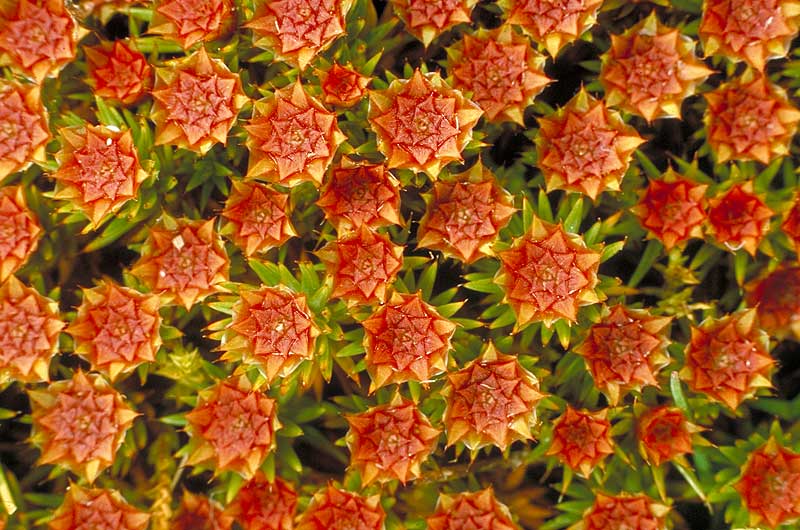
Polytrichum juniperinum - male plants

I'll leave you with these images found via Seed Capsules tumblr.


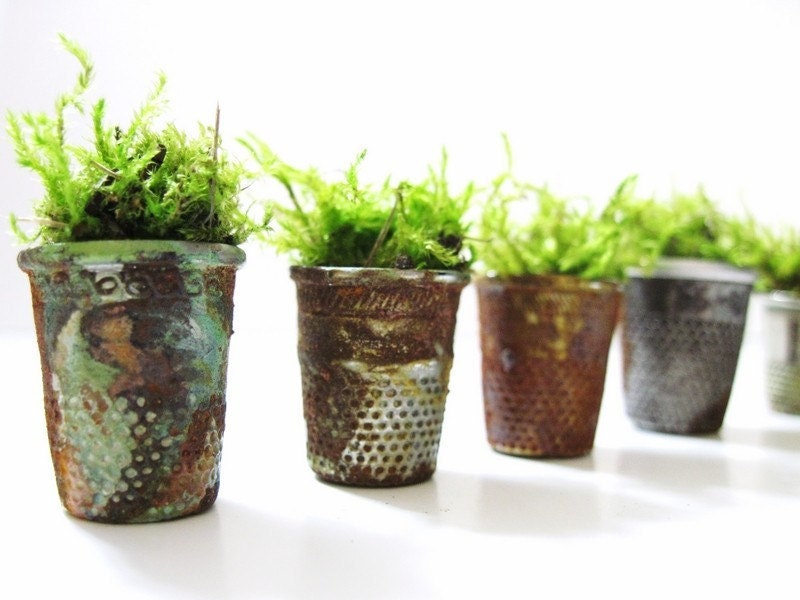
Moss terrarium found here
Vintage Thimble Planters and Moss Terrariums recycling plants
Moss terrarium found here


Set of 4 Vintage Thimble Planters with Live Moss
Moss thimbles Found here


Moss image via here


Friday, March 30, 2012

thinking about seeds in the context of mining developments


Whist at the Millennium Seedbank in the UK last October I had an interesting conversation with a number of staff over the three week stay...

my ever expanding collection of journals and artist books


One of the people who left me thinking was Vanessa Suttcliffe who's work at the Kew Millennium Seedbank has seen her involved in the following projects:


One area we discussed was the Difficult Seeds Project in Africa ...do read abut that if you have a chance! Another issue that has kept me thinking involves MSB training for Mining companies who undertake Land Stewardship by setting up pre-comencement seed conservation and post-mining restoration work. Vanessa detailed the processes available to companies in the work of Land Stewardship but I could only gather that uptake is not what it could be.

Months later I wonder how often and how many companies actually choose to put into practice this kind of undertaking... expecially in the light of all the noise on CSG mining and general expansion of the industry in this state and beyond. It seemed for a brief moment there might be movement in the direction of sustainability in that industry ... and certainly some countries have done just that. Practices and commitments have been made to foster improvements in this sector but I for one would like to see evidence of it happening in this state... and across the country. At present the Seed lab I worked in during my 2010 residency is not open due to lack of funding.

Given mining expansion in Queensland it seems the very least that could be done is the critical work of collecting wild species from across the state in the effort to monitor seed viability and such. This leaves me questioning what measures are in place to scientifically monitor the changing environment. From what I have learnt to date seeds are actually an incredibly useful and important measure.

Politics and Money, jobs and economy are the big buzzwords... but in terms of longevity... a longer sense of the NOW... what will stack up. This has to be considered far more earnestly ... and might I say far more honestly!

I'll leave you will these images... bye for now!

Drawing with children one day we innovated with our drawing tools


this tiny Casuarina branch became an ink pen... I often use twigs for the earthy Quality they give to linework.


Thursday, March 22, 2012

Coal seam gas tenements in Brisbane suburbs

Media: Coal seam gas tenements in Brisbane suburbs - Lock the Gate News

I just found this story on the LOCK THE GATE WEBSITE written by Drew Hutton, president of the Alliance on March 19th. Its worth noting that this information is not being publicly released through any mainstream media source that I know of at this time.

Quoted from the website:

A large coal seam gas exploration permit has been granted over a large part of Brisbane's western suburbs.
The permit, known as EPP641 is owned by BNG Pty Ltd which is a subsidiary of the large CSG company, Arrow which is, in turn, owned 50-50 by the multi-national corporations, PetroChina and Shell.
Suburbs of Brisbane covered by the EPP include Moggill, Pullenvale, Karana Downs and Brookfield and the tenement comes within a kilometre or so of the Kenmore shopping centre.
Lock the Gate Alliance president, Drew Hutton, said it should come as no surprise that resource companies would look for coal or gas in metropolitan areas.
"Dart Energy, also owned by PetroChina and Shell, is drilling in the inner suburbs of Sydney, there are coal seam gas EPPs over Toowoomba, the Acland coal mine expansion has taken out the town of Acland and there are coal exploration permits over parts of Maryborough," Mr Hutton said.
"These companies don't like to acknowledge limits and the state government is reluctant to impose them on resource companies.
"For example, Arrow's recently-completed environmental impact statement allows for coal seam gas wells to be placed within 200 metres of someone's house.
"Anyone living in Brisbane who thinks they are necessarily removed from the risks of high-impact resource extraction near them should think again," Mr Hutton said.


Click to view large map!

When I googled this story there was mention of this being a ten year old permit, with no intention of mining going ahead in this area. It seems those statements are trucked out time and again, only to see the go-ahead of development afterwards. You can be sure the Alliance is tracking things very closely as all across the country and around the world people are talking about fracking and lack of community consultation. Despite all denials of intention the companies move in and things are under way before communities can do much!

Read more here!


This comes from the website for Coal Gas Seam News:
          What can I do?
Dare to stand up. Don’t just think about yourself, think about your grandchildren and beyond.

Monday, March 19, 2012

CAN YOU HELP? The biggest issue where I live...


is the current expansion in the mining industry. 

The news from those living with mining companies on their doorstep in the SEQ region where I live is looking distinctly bitter.
This is not a NO MINING rant. I live in a state and country that relies hugely on the Mining Industry. Mining is not going to disappear from the landscape of this country whilst-ever resources exist.
What we are questioning here are issues around where Mining is permitted in Australia...
the questions of where + when + how + why + by whom + for what outcomes! Questions it's our right to ask and be answered on. As custodians of the future it is up to us after all!

You can help us by sharing this story!

Tomorrow onwards many networks will be sharing these posters... primarily the top one about farming. Emails, Facebook, Twitter, Linked-in, Pinterest ... just a few clicks of a mouse to your list of contacts. SHARE THIS POST TOO (look at bottom of post for links!)
scan these links:
ABC NEWS SPECIAL
LOCK THE GATE ALLIANCE
THE CONVERSATION
SIX DEGREES
GET-UP
U_TUBE: AERIAL VIEW OF TARA QLD

Share this poster:


q: why?
a: many feel consultation + debate has been completely denied and we need to learn much more about whats happening!

Last Monday I attended the Forum on Food Security in Brisbane. Many from the Farming and Tourism Sector were present to hear the stories of 6 women who's families, homes, communities and futures are being enormously affected by CSG and Open cut mining ventures that have come into their communities with little or NO community consultation. I wrote this post to relate information from that event.

This is prime Agricultural land... a 'Food Bowl' well known across this Continent. The vast water systems that cover the eastern states are also gravely implicated as being at risk...and health reports from families living next to Gas drilling paint desperate pictures. People's homes and properties slide in value and some just cant afford to move their families. There is no compensation!


                If you care to know more and learn more you can read the links above.


Please join us in sharing this post if you can ... the posters and links ... in whatever way you can. The story wont be over anytime soon without us being part of the changes we wish to see!


"For most wild things on earth, the future must depend on the conscience of mankind"  Dr. Archie Carr  
Via Megan Barnes


PS. THis morning (March 20th)  blogger Rhonda Ayliffe from ART & LIFE posted "a little left of field" on her blog about this issue. An artist on a farm in the beautiful south coast of NSW she understands absolutely what this means for the land, the farmers, the livelihood of communities and individuals.
I've taken this piece below from her writing for you to read ... do visit her blog to read the whole piece... she's a lively thinker, commenting on life in a wonderful country region... and the Art Practice she conducts from there!


"This is about mining our (aussie) farmlands - the damage it does to farmland and the environment, to families and rural communities. I'm lucky that our farm is not directly threatened (at the moment.... the big survey planes scanned our area for mining potential last year.... we seriously considered bringing out the shotgun and taking a potshot at the low flying bastards.... but I digress...)

For those of you not aware - Australian farmers do not own the mineral rights on their properties. This is controlled by the government (generally this means State government) - and the government can (as it does) give any company it favours open slather on our farms.  Our nation's prime farmlands are being turned into mining wastelands and farming families and rural communities are tossed aside without a thought (and even less financial compensation... not that your heritage has a price tag). All for a minuscule mining royalty (please follow the given links for all the facts and figures - including the percentage of overseas ownership of mining operations). It is a desperate and dreadful situation and one that I feel personally incensed by."


Thanks Ronnie ... may she inspire you to discuss these matters or ones of similar importance in your communities ... wherever you are!

The seed emergency: The threat to food and democracy

The seed emergency: The threat to food and democracy - Opinion - Al Jazeera English

This article came to my attention tonight via twitter and is from a story reported at ALJAZEERA... widely shared since being published in early February this year.

Dr Vandana Shiva is a physicist, eco-feminist, philosopher, activist and author of more than 20 books and 500 papers. She is the founder of the Research Foundation for Science, Technology and Ecology, and has campaigned for biodiversity, conservation and farmers' rights, winning the Right Livelihood Award [Alternative Nobel Prize] in 1993.


File:Vandana Shiva, environmentalist, at Rishikesh, 2007.jpg
Dr Vandana Shiva


Vandana Shiva Activist and author Dr Vandana Shiva is the founder of the Research Foundation for Science, Technology and Ecology.


The views expressed in this article are the author's own and do not necessarily represent the editorial policy of Al Jazeera.


I had a thorough read of this article to work out what to excerpt for posting here. Its all critical material on seeds and rather than pick bits of it I am reblogging the entire article for its comprehensive coverage of whats happening in the realm of seeds, especially in relation to agriculture. 


Last year I had proposed originally to go to India to visit Navdanya, the Institute set up by Vandana Shiva. The Navdanya link below to their website is not currently working... this link takes you to Wiki! 
The trip to the UK ended up being more than enough for me to tackle... so India is a possibility perhaps for a later date. I'd exchanged warm correspondence with the staff at the Institute so was sorry to not make the trip.


From ALJAZEERA:


New Delhi, India - The seed is the first link in the food chain - and seed sovereignty is the foundation of food sovereignty. If farmers do not have their own seeds or access to open pollinated varieties that they can save, improve and exchange, they have no seed sovereignty - and consequently no food sovereignty.
The deepening agrarian and food crisis has its roots in changes in the seed supply system, and the erosion of seed diversity and seed sovereignty.
Seed sovereignty includes the farmer's rights to save, breed and exchange seeds, to have access to diverse open source seeds which can be saved - and which are not patented, genetically modified, owned or controlled by emerging seed giants. It is based on reclaiming seeds and biodiversity as commons and public good.
 Farmer suicides spike in India
The past twenty years have seen a very rapid erosion of seed diversity and seed sovereignty, and the concentration of the control over seeds by a very small number of giant corporations. In 1995, when the UN organised the Plant Genetic Resources Conference in Leipzig, it was reported that 75 per cent of all agricultural biodiversity had disappeared because of the introduction of "modern" varieties, which are always cultivated as monocultures. Since then, the erosion has accelerated.
The introduction of the Trade Related Intellectual Property Rights Agreement of the World Trade Organisation has accelerated the spread of genetically engineered seeds - which can be patented - and for which royalties can be collected. Navdanya was started in response to the introduction of these patents on seeds in the General Agreement on Tariffs and Trade - a forerunner to the WTO - about which a Monsanto representative later stated: "In drafting these agreements, we were the patient, diagnostician [and] physician all in one." Corporations defined a problem - and for them the problem was farmers saving seeds. They offered a solution, and the solution was to make it illegal for farmers to save seed - by introducing patents and intellectual property rights [PDF] on those very seeds. As a result, acreage under GM corn, soya, canola, cotton has increased dramatically.
Threats to seed sovereignty
Besides displacing and destroying diversity, patented GMO seeds are also undermining seed sovereignty. Across the world, new seed laws are being introduced which enforce compulsory registration of seeds, thus making it impossible for small farmers to grow their own diversity, and forcing them into dependency on giant seed corporations. Corporations are also patenting climate resilient seeds evolved by farmers - thus robbing farmers of using their own seeds and knowledge for climate adaptation.
Another threat to seed sovereignty is genetic contamination. India has lost its cotton seeds because of contamination from Bt Cotton - a strain engineered to contain the pesticide Bacillus thuringiensis bacterium. Canada has lost its canola seed because of contamination from Roundup Ready canola. And Mexico has lost its corn due to contamination from Bt Cotton.
After contamination, biotech seed corporations sue farmers with patent infringement cases, as happened in the case of Percy Schmeiser. That is why more than 80 groups came together and filed a case to prevent Monsanto from suing farmers whose seed had been contaminated.
As a farmer's seed supply is eroded, and farmers become dependent on patented GMO seed, the result is debt. India, the home of cotton, has lost its cotton seed diversity and cotton seed sovereignty. Some 95 per cent of the country's cotton seed is now controlled by Monsanto - and the debt trap created by being forced to buy seed every year - with royalty payments - has pushed hundreds of thousands of farmers to suicide; of the 250,000 farmer suicides, the majority are in the cotton belt.
Seeding control
Even as the disappearance of biodiversity and seed sovereignty creates a major crisis for agriculture and food security, corporations are pushing governments to use public money to destroy the public seed supply and replace it with unreliable non-renewable, patented seed - which must be bought each and every year.
 Inside Story: Averting a world food crisis
In Europe, the 1994 regulation for protection of plant varieties forces farmers to make a "compulsory voluntary contribution" to seed companies. The terms themselves are contradictory. What is compulsory cannot be voluntary.
In France, a law was passed in November 2011, which makes royalty payments compulsory. As Agriculture Minister Bruna Le Marie stated: "Seeds can be longer be royalty free, as is currently the case." Of the 5,000 or so cultivated plant varieties, 600 are protected by certificate in France, and these account for 99 per cent of the varieties grown by farmers.
The "compulsory voluntary contribution", in other words a royalty, is justified on grounds that "a fee is paid to certificate holders [seed companies] to sustain funding of research and efforts to improve genetic resources".
Monsanto pirates biodiversity and genetic resources from farming communities, as it did in the case of a wheat biopiracy case fought by Navdanya with Greenpeace, and climate resilient crops and brinjal (also known as aubergine or eggplant) varieties for Bt Brinjal. As Monsanto states, "it draws from a collection of germ-plasm that is unparalleled in history" and "mines the diversity in this genetic library to develop elite seeds faster than ever before".
In effect, what is taking place is the enclosure of the genetic commons of our biodiversity and the intellectual commons of public breeding by farming communities and public institutions. And the GMO seeds Monsanto is offering are failing.  This is not "improvement" of genetic resources, but degradation. This is not innovation but piracy.
For example, the Alliance for a Green Revolution in Africa (AGRA) - being pushed by the Gates Foundation - is a major assault on Africa's seed sovereignty.
Agribusiness
The 2009 US Global Food Security Act [PDF] also called the Lugar-Casey Act [PDF], "A bill to authorise appropriations for fiscal years 2010 through 2014 to provide assistance to foreign countries to promote food security, to stimulate rural economies, and to improve emergency response to food crisis, to amend the Foreign Assistance Act of 1961 and for other purposes".
The amendment to the Foreign Assistance Act would "include research on bio-technological advances appropriate to local ecological conditions, including genetically modified technology". The $ 7.7bn that goes with the bill would go to benefit Monsanto to push GM seeds.
"Royalties for Monsanto are based on debt, suicidal farmers and the disappearance of biodiversity worldwide."
An article in Forbes, titled "Why Uncle Sam Supports Franken Foods", shows how agribusiness is the only sector in which US has a positive trade balance. Hence the push for GMOs - because they bring royalties to the US. However, royalties for Monsanto are based on debt, suicidal farmers and the disappearance of biodiversity worldwide.
Under the US Global Food Security Act, Nepal signed an agreement with USAID and Monsanto. This led to massive protests across the country. India was forced to allow patents on seeds through the first dispute brought by the US against India in the WTO. Since 2004, India has also been trying to introduce a Seed Act which would require farmers to register their own seeds and take licenses. This in effect would force farmers from using their indigenous seed varieties. By creating aSeed Satyagraha - a non-cooperation movement in Gandhi's footsteps, handing over hundreds of thousands of signatures to the prime minister, and working with parliament - we have so far prevented the Seed Law from being introduced.   
India has signed a US-India Knowledge Initiative in Agriculture, with Monsanto on the Board. Individual states are also being pressured to sign agreements with Monsanto. One example is the Monsanto-Rajasthan Memorandum of Understanding, under which Monsanto would get intellectual property rights to all genetic resources, and to carry out research on indigenous seeds. It took a campaign by Navdanya and a "Monsanto Quit India" Bija Yatra ["seed pilgrimage"] to force the government of Rajasthan to cancel the MOU.
This asymmetric pressure of Monsanto on the US government, and the joint pressure of both on the governments across the world, is a major threat to the future of seeds, the future of food and the future of democracy.

This part below is of interest:

Since 2004, India has also been trying to introduce a Seed Act which would require farmers to register their own seeds and take licenses. This in effect would force farmers from using their indigenous seed varieties. By creating a Seed Satyagraha - a non-cooperation movement in Gandhi's footsteps, handing over hundreds of thousands of signatures to the prime minister, and working with parliament - we have so far prevented the Seed Law from being introduced.


For many of us... to learn the right to access seeds in ways that have been universally practiced since the earliest of times is threatened ... and that the battle has been lost in some places is staggering ... One has to wonder at our idea of civilisation that we do what is reported here to the extraordinary inheritance that is our seed heritage.


Related Posts Plugin for WordPress, Blogger...