Friday, July 6, 2012

Rainforest fruits, seed pods and findings from the Wet Tropics of North Queensland


This what I brought back from Cairns in far north Qld last week. I found a large platter I serve fruit on and filled the tray completely with this abundance of collected items... from the blue quandongs flicked up off the ground at the Cairns Botanic Gardens to black bean seeds pods from the Daintree River Ferry area.


My imagination is well and truly fired up by all that I saw up north. These are destined for the studio... some of them Ive already taken time to draw...


I'm due to return north for a month from September 18th to undertake a 4 week residency with an exhibition following. Stay tuned on  this and read more at the website, on  my blogs or Facebook page... all links are in the right sidebar! 

For now I am gearing up to run workshops and a course, paint and invite the public to view the work at my studio...all part of a program to see that this next phase of work is communicated and funded. 

Email me here if you wish to have this program sent to you!  When it gets hugely busy one does find it difficult to find enough time in keep posting on blogs and so on.... but its wonderful to share the stories and hear from others so I will do my best!
       Best wishes all!
                         Sophie

Wednesday, June 27, 2012

A week in the Wet Tropics region of Northern QLD


So much to share here but not much time with only 24 hours left up in Cairns before I head back to Brisbane after a week getting acquainted with the area and the place where I will do a residency in September/October.... Tanks Arts Centre and Cairns Botanic Gardens. I wrote a couple of posts on this trip at the other two blogs... one about visiting the World Heritage Site at the Daintree National Park...


Mossman River at the Mossman Gorge

The other post about my new journal and drawings of pods and rainforest fruits I've been collecting.


the new journal


Click those links to go see the images.
   Back home soon!
      Sophie


Wednesday, June 13, 2012

Planning for an exciting Residency and moving to a new studio!


This past month could not have been busier!

Photos of work from the May IMB residency at the University of Queensland have yet to be completed for posting because no sooner was that concluded than a 12 month studio residency in Paddington, Brisbane came up... and also a month long residency in Cairns this September/October. 


image: www.wettropics.gov.au

This will offer a wonderful opportunity to delve further into the rainforest species of the wet tropics... work started during the 2010 residency at Brisbane Botanic Gardens. I will also be looking much more into the Rainforest Aboriginal Heritage and connecting with the Botanic Gardens Staff and other key organisations in the area.

There has been so much press of late about the Great Barrier Reef and proposed mining development that I am sure this experience is bound to bring much to light.

Great Barrier Reef

Cairns
Its been something I've hoped to do for years ... travel north to see this extraordinary region. Whilst the planning for this has been taking place I was given the keys to the studio that I spent 6 months in during late 2010 thanks to Helena Lloyd, owner/director of Percolator Gallery (the studio is situated under the gallery).


Last week I trundled my journals and art materials across town...15 minutes from home... and set up studio and began painting! Read the post on the new studio at the studio archive blog... it includes a whole series of photos of work from the last week.


Now my only challenge is to keep up with these wonderful opportunities!

I hope to get back to routine posting soon... there's been much to share and when it gets really busy Twitter and the Homage to the Seed Facebook page is where you swill find me if there's a chance to go online!


Monday, May 14, 2012

Inviting you to a special ONE DAY ONLY show of work from the IMB residency this Friday!

The Institute of Molecular Bioscience

is hosting a show of

Artworks by Sophie Munns this Friday, May 18


In honour of the first ever International Fascination of Plants Day this Friday, May 18th, The University of Queensland's Institute for Molecular Bioscience is presenting a show of artwork by Sophie Munns on completion of a 3 week residency collaborating with Scientist Dr Joshua Mylne. 


About: Three weeks has provided a rich and timely introduction to the field of Molecular Plant Science through dialogue and observation, journal keeping, photography, drawing and painting. Communications onsite aided this steep yet stimulating challenge to absorb new learning, in what was for the artist, an entirely unfamiliar realm of Plant Science.


When:  10am till 4pm, Friday 18th of May. 


Where: Building 80, Institute of Molecular Bioscience, University of Queensland.
              Sitemap available through IMB website here.


Why: 
Learn more about this recent undertaking and how it came about at this April post. Whilst on residency at the KEW Millennium Seedbank in the UK last October the immensity of knowledge around past endeavours in Plant Science only became more obvious as did the current "explosion" of developments in contemporary Plant Science ... bringing so many more questions to light, and  provoking a new determination to learn more at first hand, wherever possible. 
Sophie has considered at length the way in which simplified arguments descend into polarised thinking around some areas of Plant Science... tending to block rather than foster community understanding... all the while increasing a sense of alarm about the future by focusing single-mindedly on the food we eat - whether it's GM or Organic, rather than fully considering the delicate balance needed for competing needs to be addressed - habitats, soil, water, shelter, energy and all the systems that make up daily life. Building bridges between the scientists and general public is more essential than ever to actively engage the community imagination to see the layers of systemic changes needed to make societies work more effectively into the future and therefore to find new and more empowered ways of participating in matters of concern and interest.


Alongside the Exhibition at the IMB this Friday is a Public Lecture event:  
                                                 NOW FULLY BOOKED 
                                         (* an audio recording of the lecture will be made available on this site asap)

 
"Plants – and the future of global food security"
A free public lecture by author, journalist, editor and science communicator -- Julian Cribb
Friday, 18 May 2012
12 midday – 1.00 pm
VENUE
'Qld Bioscience Precinct Seminar Room'
(Building 80 – entrance via Chancellor Place, St Lucia Campus)

"Lecture fully booked* "
Tel: (07) 3346 0553

(* an audio recording of the lecture will be made available on this site asap)


All are welcome for this one-day Art showing at the IMB... so do come along and discover what it's all about this Friday if you are able to make your way to UQ. The Bus terminal is outside the IMB ... also not too far is the Citycat terminal on the river! 
For those unable to attend Images will be added to the website and blogs with prints of some works available for purchase.


Visit the NEW tumblr blog celebrating Fascination of Plants Day which was set up on the weekend.


On a personal note...
         Welcome and thank you to all the new subscribers... its been a frantic few weeks and I look forward to catching up with many in the blogging community after this weekend.
Ciao,
Sophie


PS: a brief E-news bulletin will go out tomorrow!

Tuesday, May 1, 2012

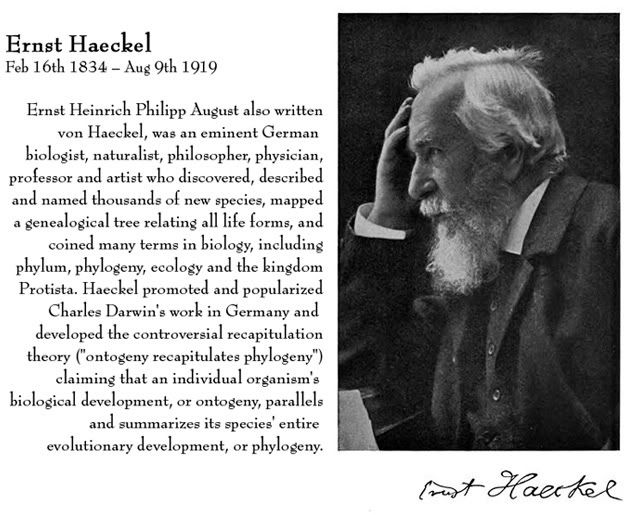
Haeckel, the Tree of Life and a new vocabulary


When I say a new vocabulary I speak for myself only as readers here may come from varied backgrounds with some of you entirely familiar with terms I'm slowly discovering, and hopefully absorbing, on this current residency and winding pathway through the diverse realm of Plant Science.

Artists are frequently                                                                                                                             drawn to images by Ernst Haeckel, although perhaps not this diagram.

File:Haeckel arbol bn.png
Genealogical tree suggested by Haeckel (1866)


Here's a link to a book written by Haeckel, translated from German which you may like to take a look at: 
Haeckel

                           A Visit to Ceylon   by Ernst Haeckel  translated by Clara Bell 1883


Photobucket
Found here.

For an excellent brief pictorial introduction read more here.

Ernst Haeckel's recapitulation theory


Genealogical tree suggested by Haeckel (1866)
During the late 19th century, Ernst Haeckel's recapitulation theory, or biogenetic law, was widely accepted. This theory was often expressed as "ontogeny recapitulates phylogeny", i.e. the development of an organism exactly mirrors the evolutionary development of the species. Haeckel's early version of this hypothesis [that the embryo mirrors adult evolutionary ancestors] has since been rejected, and the hypothesis amended as the embryo's development mirroring embryos of its evolutionary ancestors. Most modern biologists recognize numerous connections between ontogeny and phylogeny, explain them using evolutionary theory, or view them as supporting evidence for that theory. Donald I. Williamson suggested that larvae and embryos represented adults in other taxa that have been transferred by hybridization (the larval transfer theory).[8][9] However, Williamson's views do not represent mainstream thought in molecular biology,[10]and there is a significant body of evidence against the larval transfer theory.[11]


Finding contributions by artists who've delved into areas of scientific research on Plants is no doubt more extensive than we commonly realise. Its a huge area of endeavour now for artists but going back in time perhaps names are still coming to light and aren't so well known outside of Botany and related sciences.

Engaging blogger Velma Bolyard reminded me in her comment at the last post of something that was a key feature of my first week just gone on residency at the Institute of Molecular BioScience here in Brisbane...    

vocabulary

Without an adequate vocabulary + effort to be acquainted with the concepts its hard to progress. Whether I will find a month affords me the kind of progress I desire is another thing... but words are streaming in and being added to my list at a great rate. This crash course is being generously provided in the main by Joshua Mylne who's profile I've borrowed from the IMB website:

Plant molecular biology and genetics for human health
Josh Mylne
Plants have more to offer than food. Not only do we find them aesthetically inspiring, but they are the source of most medicines, the fibres we wear and the materials with which we build our houses. Plants can also be an ideal system for studying basic biological phenomena. We are using Arabidopsis thaliana, a model plant used by over 16,000 labs worldwide, to overcome barriers to protein drug production and to discover the mode of action for market drugs. In the first, we are examining the machinery employed by sunflower to process a small drug-like protein ring from within a much larger seed protein. We use genetic and transgenic approaches in Arabidopsis to understand and improve their ability to process these protein rings. In the second, we are using the surprisingly close relationship between plants and the malarial parasite Plasmodium falciparum to understand how an antimalarial drug works before the parasite finds a way to overcome it, which is essential if we are ever going to predict how malaria may acquire resistance to drugs in use today.
Projects include:
  • A new genetic system for studying anti-malarial drug resistance,
  • An ancient genetic origin for drug-like molecules in daisy seeds.


In addition many others have been most helpful. Research assistants to Joshua Mylne, Amy Argyros and Aurelie Chanson,  demonstrated Lab work on Friday and accompanied me to a most stimulating lecture by Robert J Henry, director of the newly formed University Institute: QAAFI  or Queensland Alliance for Agricultural and Food Innovation. I scribbled notes on ten pages during the hour-long talk and noted with keen interest his focus on indigenous plants and detailed inclusion of Biodiversity in his rationale for new directions. In fact... this talk contained numerous threads I've been following for some time, wondering how I might gain more info, especially for this state, re some of the questions that have emerged for me.

                                        -

                                Go to this page to find a flyer on the International Fascination of Plants Day... 
                                       the reason for this current collaboration organised through Joshua Mylne at the IMB.


On the Vocab list so far:

Sessile or sessility: In botany, sessility (meaning "sitting", used in the sense of "resting on the surface") is a characteristic of plants whose flowers or leaves are borne directly from the stem.

Synteny:  is a newly coined term meaning "on the same ribbon"; Greek: σύν, syn = along with + ταινία, tainiā = band. A concept relating to genetic linkage.


Phylogeny: This simple diagram provides a useful overview.

Image found here

and by way of comparison this more complex algorithm - above - found here.


Phylogenetics: In biology, phylogenetics (play /faɪlɵdʒɪˈnɛtɪks/) is the study of evolutionary relation among groups of organisms (e.g. species,populations), which is discovered through molecular sequencing data and morphological data matrices. The termphylogenetics derives from the Greek terms phyle (φυλή) and phylon (φῦλον), denoting “tribe” and “race”;[1] and the termgenetikos (γενετικός), denoting “relative to birth”, from genesis (γένεσις) “origin” and “birth”.[2]
Taxonomy, the classification, identification, and naming of organisms, is richly informed by phylogenetics, but remains methodologically and logically distinct.[3] The fields of phylogenetics and taxonomy overlap in the science of phylogenetic systematics — one methodology, cladism (also cladistics) shared derived characters (synapomorphies) used to create ancestor-descendant trees (cladograms) and delimit taxa (clades).[4][5] In biological systematics as a whole, phylogenetic analyses have become essential in researching the evolutionary tree of life.

Phylogenomics: Phylogenomics is the intersection of the fields of evolution and genomics.[1] The term has been used in multiple ways to refer to analysis that involves genome data and evolutionary reconstructions. It expands earlier phylogenetics. Phylogenomics draws information by comparing entire genomes, or at least large portions of genomes. Phylogenetics is smaller in scope and compares and analyzes only single genes, or a very small number of genes.[2] Three major areas fall under phylogenomics:
  • Prediction of gene function
  • Establishment and clarification of evolutionary relationships
  • Prediction and retracing lateral gene transfer

                                                                                                                            NB: All found at Wiki!


449725455_de2ee7141f.jpg
Image link from this blog: Bioephemera - Jessica Palmer has a PhD in Molecular Biology
 and has been blogging about the intersection of art and biology since 2006. NB: image link
given by Palmer is no longer current... so here is no title or name of artist supplied.

Of course I could keep going - there's endless material I keep finding.... but its already too much informations i'm sure.
             Till next time, thanks for popping in here!
S
Related Posts Plugin for WordPress, Blogger...