Wednesday, March 23, 2011

Celebrate World Water Day Every Day by Conserving Water


Following on from yesterday's post on World Water Day I want to share this piece found at Huffington Post via twitter written by

Jim Lauria

Posted: March 22, 2011 11:58 AM


He brings attention here to less obvious ways to conserve water.

Read your water bill. As water reserves dwindle, water rates will steadily rise meaning saving water will save you even more money
Irrigate Less.
In the world at large, about 70% of water used by mankind goes for irrigation, 20% for industry and 10% to public consumption. The average home is a microcosm of this with 70% of the water going to irrigate lawns and gardens, 20% for bathing, clothes-washing and toilet flushing, the rest for drinking and cooking. Better management of home water for irrigation -- like xeriscape landscaping, choosing low water vegetation, and drip irrigation practices -- can save the largest expenditures of water in a home.
Eat more vegetables.
Not only is this healthy (read Michael Pollan's In Defense of Food), but getting more nutritional value from non-meat sources saves a lot of water. It takes a little over 100 gallons of water to produce one pound of corn while a 16-ounce steak is equivalent to 2000 gallons of water (think about over 30 55-gallon drums of water sitting on your plate!) based on the amount required to feed, raise, slaughter, and transport the beef.
Buy things that last.
Besides water embedded in food products (see www.waterfootprint.org) our throw-away society has produced landfills full of discarded products, making them vast reservoirs of entombed water. Landfills have an additional impact when their runoff contaminates groundwater reserves.
Conserve electricity.
It takes a tremendous amount of water to cool nuclear power plants, to pump oil from its underground deposits, to scrub coal-fired furnaces, and to grow and process biofuels. Save electricity and you save water.
Recycle.
It takes an enormous amount of water (not to mention energy -- see above) to produce paper, aluminum and glass by extracting virgin raw materials from the earth. Our society should take William McDonough's advice from his book Cradle to Cradle and design every product to become the feedstock of another product after its useful life.
Drive less.
According to Michael Webber in his 2008 Scientific American article, "Catch 22: Water vs. Energy," driving 100 miles in a gasoline-powered auto consumes between seven and 14 gallons of water. And while alternative fuel vehicles like hybrids, hydrogen fuel-cell and ethanol cars use less petroleum, they deplete significantly more water than traditional automobiles. Walking, riding a bike, taking public transportation all help with water conservation.

Another twitter find... Barry Eastabrook:

read more here at this writer's excellent blog: politics of the plate

TomatolandcoverBIG


You'll find some excellent articles at this site.

He was formerly a contributing editor at the late lamented Gourmet magazine. He now serves on the advisory board of Gastronomica, The Journal of Food and Culture, and writes for the the New York Times, the Washington Post,TheAtlantic.com, MarkBittman.com, Saveur, Men’s Health, and pretty much anyone else who will take his stuff.
His article for Gourmet on labor abuses in Florida’s Tomato fields received the 2010 James Beard Award for magazine feature writing. Read it here.
His book about how industrial agriculture has ruined the tomato in all ways–gastronomic, environmental, and in terms of labor abuse–will be published in the summer of 2011 by Andrews McMeel.
Dont miss the previous post on World Water Day!

WORLD WATER DAY!


Homage to the Seed pays tribute today to water... something so essential to life on this planet!


sophie munns
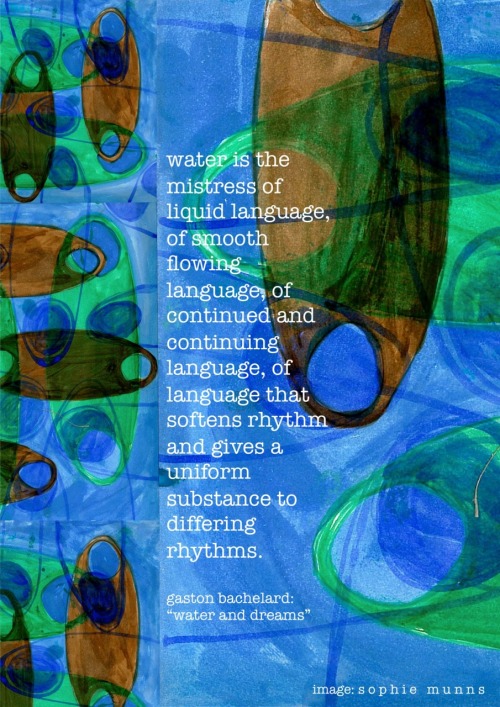
For a number of years my artwork explored water and fluidity... an incredibly rich area
for exploration ... this image is posted here at Seed Capsules.


March 22nd has been chosen to celebrate the UN World Water Day 2011
... links to the UN site here.

This is the first time in human history that most of the world's population live in cities: 3.3 billion people ...and the urban landscape continues to grow.


38% of the growth is represented by expanding slums, while the city populations are increasing faster than city infrastructure can adapt.

The objective of World Water Day 2011 is to focus international attention on the impact of rapid urban population growth, industrialization and uncertainties caused by climate change, conflicts and natural disasters on urban water systems. 

This year theme, Water for cities: responding to the urban challenge, aims to spotlight and encourage governments, organizations, communities, and individuals to actively engage in addressing the challenges of urban water management.

You'll find much more at the Un website link above.

I also want to link you to Robyn at her wonderful blog: "fragments  treasures  memory" where she celebrates this important day with a wonderful post & excellent links ... you can visit here. 
Robyn is one of those animated individuals who makes a point of getting dialogue going through her blog to prompt stronger connections to what is important on this planet. Passion with equal measure equanimity and warmth ... its always a pleasure to visit Perth-based Robyn. Do visit and say I  sent you along!


image found through Seed capsules


vapours:

by Louisiana Mei Gelpi
for an interesting read:  Salina Art Cemtre in the US is putting this event on later this year....looks fascinating...  love to be involved in something like this!


July 08, 2011 — June 17, 2012

Streams of Consciousness: The Histories, Mythologies, and Ecologies of Water

Recalling the Latin phrase Sine Qua Non (Without Which Nothing), the investigation of the nature of water and its relationship to humankind is a timely journey of beginnings, transformations, and critical necessities. Being one of the planet’s most vital natural resources, water is essential for life, embodying the chance of life or death in every drop. In all its forms—gas, liquid, solid—water permeates the fiber of every living being on earth and often goes unacknowledged until rivers run dry or bodies grow parched. 
Many of today’s artists are sensitive to water’s significant and complex role on earth. Through a broad range of perspectives and artistic practices, these artists brave the ambiguous tides and unknown depths to tap water’s myriad meanings and associations. Whether responding to the fantastical tales of seafaring pirates or the privatization of freshwater, artists gaze toward a watery horizon for discoveries and understanding of how water informs contemporary culture.
The Salina Art Center’s forthcoming exhibition approaches the topic of water on macro and micro, local and global scales. Including national and international artists and artist groups, the exhibition will unfold in three “waves” over the course of one year, providing ample time to fully plumb this seemingly boundless subject.  While conceptually organized into three distinct waves,—histories, mythologies, and ecologies—the physical manifestation of the exhibition and the related public programs will reflect the organic nature of water: diverse ideas, perspectives, and conversations will amorphously flow throughout this open-ended system of experimentation and discovery.

CURRENTS: Community Conversations about Water
In preparation for Streams of Consciousness, the Salina Art Center will host a series of public forums to establish a critical, community-wide discourse about the topic of water. Free and open to all, these focused conversations will be facilitated by the Swim Team—a group of area water specialists—and visiting artists researching water issues in Kansas.

Read more here!


Monday, March 14, 2011

News From Japan - Kurashi - The "Eco-Blog" - by Martin J Frid


Liked this cover of a book on Japanese food... sorry... not posting n this book as such! 

Natto that is tradition food of Japan
Natto - an ancient and traditional Japanese fermented food made from soybeans -
nutritious and low in calories. Click here

Trawling the internet tonight I came across a blog by Martin J Frid that of course contained posts about the tragic events of the past 4 days in Japan... but also contained quite fascinating earlier posts on all things eco-related.

This one on Soybeans  I thought very suitable to post on here at Homage to the Seed. And following that one on Seed-saving - in Japan.!

Wednesday, February 16, 2011


Soybean Field Trust Movement (Daizu Trust) And Efforts To Make Rural Japan Cool Again - click here.


I went to a fun meeting today with the Soybean Field Trust Movement people, including farmers and consumers, who are trying to encourage interest in locally grown soy. One speaker noted that in Ibaraki Prefecture (considered No. 2 after Hokkaido for soy production) a recent inventory revealed over 100 different varieties. Much soy in Japan is used for tofu, miso and soy sauce. Did you know that soy is used as edamame, often as a snack?

The Soybean Field Trust Movement started some 13 years ago, when it became clear that imported soy from the US was increasingly genetically modified, and controlled by large multinational corporations like Monsanto. On top of that, the soy that Japan imported from Latin America was found to lead to the destruction of the Amazon forests.

Japan still imports a lot of soy, but companies like Honda Motor Co. (!) have set up special silos in North America that only accepts non-GMO soy:

In Ohio, non-GMO soybean acreage increased 6%, the largest increase in any state. "We saw more growers switching to non-GMO production for 2009 planting,” says Joe Hanusik, manager at Harmony Agricultural Products In Ohio (HAPI Ohio), which produces non-GMO soybeans for food use. HAPI Ohio is owned by the Honda Motor Company, based in Japan. Honda ships containers to the US filled with automobile parts, and HAPI Ohio ships them back to Japan filled with non-GMO soybeans. The infield of a Honda test track in Marysville, Ohio, is even planted with non-GMO soybeans. Hanusik said he contracted with a record number of farmers to plant non-GMO soybeans. "This year we are producing roughly 45,000 acres of non GMO soybeans. Last year we were right around 25,000.” Steve Waddell, a farmer near Columbus, Ohio, switched to non-GMO production because of the higher premiums. Waddell says he will earn a $2.00 premium for non-GMO soybeans this year.


Be that as it may, soy bean farmers around Japan feel a keen sense of responsibility to carry on traditional farming methods and food culture.

Soybean Field Trust Movement is active around Japan, and do try to find them, and join their activities. If their blogs are anything to go by, they are truly doing their very best to make the rural Japan experience something worth writing home about:

Gifu Prefecture
Yamagata Prefecture
Ibaraki Prefecture (one of several)
Saitama Prefecture (Supported by local politician)
Hokkaido (NPO, one of many)

You can order Soybean Field Trust products via the PAL Network (Ibaraki). I also recommend soybeans and other products from Warabemura (English).

Mamejin has a pretty complete list of everyone who is part of this amazing movement.

Marukawa Miso was at the meeting today, they are a riot. Hey: "Money is more important than life itself!" 


Thursday, December 02, 2010


A Farmer's Tale: From Nagasaki With Love -click here.


I just loved this essay on GreenJapan.com, a website I like: Seed saving is an integral part of farming, yet these days, almost noone seems to know how to do it. As much as I like organic food, most of the organic farmers depend on conventionally produced seed for their vegetables and produce. Yes, the organic standards want farmers to avoid pesticides and chemical fertilizers, and no genetically modified organisms (GMO) are permitted.

That is all good, as far as I am concerned. But what we really need is organic farmers like Masatoshi Iwazaki, who has practiced organic agriculture and own seed banks in Azuma, Unzen City, Nagasaki for over 30 years. He is also the head of Slow Food Nagasaki.

Why is saving your own seeds so important?

In 1982, he started planting kuroda-gosun carrots, a variety native to Nagasaki, from his own seed selections. After a few years, he expanded to other varieties of vegetables and soon became hooked on the fascinating process. “True farming involves the maintenance and care of your crops over the entire lifecycle, from seed to flower to harvest and back to seeding again,” Iwasaki explained with passion.

The process of selecting your own seeds and strains is not easy and Iwasaki has encountered many issues over the years. For example, carrots selected for aesthetic appeal did not produce lots of seeds. Iwasaki says that plants are just like people. Just as there are many types of body shapes and sizes, healthy vegetable crops need to have a variety of properties.

Iwasaki believes that in this modern day and age, as seed producers focus less on variety and more on standardization, diversity on the farm takes on two increasingly important aspects. One of these is breeding variety. For example, while we may think a turnip is just a turnip, there are in fact many types of turnip from all over Japan and this variety should be preserved and treasured.

The second is variety within each crop. Kuroda-gosun carrots may come in many shapes and sizes but all of these are important and useful. However, preserving both kinds of diversity is not the exclusive domain of the farmer, responsibility also lies with the consumer. If people take time out to purchase local varieties of vegetables and are tolerant of variety in shape and appearance then it will be easier for farmers to produce a variety of crops, including locally native plants.

I like this approach to organic farming, and I understand how important it is to save seeds. Yet, isn't it strange that so few farmers share the views of Iwasaki? In fact, faced with huge pressure to change Japan's trade rules, and even totally abandon local farmers with agreements like the Trans Pacific Partnership (TPP) to allow unlimited food imports, it would make a lot of sense to at least start to support organic farmers who know what they are doing.

This could then lead to export opportunities like what Iwasaki has found:

While local plant varieties have been decimated as farmers avoided crops that did not appeal to consumers, recently there has been a revival in popularity of traditional vegetables. Take, for example, Unzen kobu takana (mustard greens). This local variety of leafy greens was the focus of an editorial published by the Radish Boya vegetable delivery service. As it turned out, Iwasaki found a local strain and revived it. Iwasaki’s Unzen-kobu takana has now been certified by Presidio, one of Italy’s most prestigious slow food organizations.

Well...

Frankly, that is not the only good reason to support organic farming in Japan. You don't just want to do this to "create more farm export" but first of all, food security and self-sufficiency should be considered. Worst case scenario: Oil imports get too expensive, and difficulties in importing/producing chemical fertilizers and pesticides? Do we really have to wait until that point to start asking organic farmers how they think Japan should feed itself?

Each of us as consumers has the responsibility to think about where the foods we are eating come from and how they are grown. And the true value of food comes from knowing the story of our food and the people who produce it. More to follow!

Need green inspiration? Head over to Eco to Waza - not to be confused with greenz.jp (both good).

Piero Sardo, President of the Slow Food Foundation for Biodiversity, has just visited Nagasaki and had this to say:

Visiting the Unzen Takana Vegetable Presidium in the prefecture of Nagasaki, followed by a meeting of the local Slow Food convivium, was extremely encouraging and showed us just how aware people here are of the issue of food biodiversity. Thanks to the area’s unique geography, with a series of deep and twisting peninsulas, it has preserved a strong cultural specificity, protected from hybrids and contamination. The recently formed Slow Food Nagasaki Convivium has already firmly oriented itself towards promoting this specificity. It is not by chance that the first and only Japanese Presidium, for the Unzen Takana Vegetable, was established here. The group of women (the consortium of Moriyama processors) who process the vegetable using traditional drying and salt fermenting methods now find it easy to sell their product, which has found space on the shelves of Tokyo’s shops and airport boutiques. The Takana growers are equally satisfied, and they participated enthusiastically in the convivium meeting.

From Resistance in Japan: Food for Thought


Iwasaki Masatoshi, another Unzen farmer, has written a great book about Slow Food farming and the delishious, organic vegetables they make by saving and farming heirloom seeds for a number of different crops.

The book, published by Shinchosha, is called Tsukuru, Taberu, Mukashi Yasai(Make, Eat, Traditional Vegetables). Born in Nagasaki in 1950, Iwasaki has almost 30 years of experience as an organic farmer, and is one of the leaders of the movement in Nagasaki prefecture. Highly recommended!
I am adding here a post that was written by our blogger on
Thursday, February 24, 2011 Click here.
Its amazing to read this post in light of the grave concerns at this moment over the nuclear power industry in japan with two reactors unstable following the earthquake ... the fact also that the after-shocks continue and so do further threats to safety!


Kaminoseki, Yamaguchi Prefecure: Controversial New Nuclear Power Plant


Kaminoseki Town comprises a peninsula and several islands. It has a population of 3,600 people. Nuclear power? The proposed construction site is on Nagashima Island which is connected by a bridge to the mainland. Iwaishima Island, which has a population of 500 people "who are almost all opposed to the nuclear power plant," is just 3.5 km across the sea from the construction site.

Pan Orient News: Five Japanese in Hunger Strike Against Kaminoseki Nuclear Power Plant (English)

In Japanese, there are a huge number of blogs, twitter and other new media using Internet to show what is going on.

Chugoku Electric Power Company operates just two nuclear power plants and is currently constructing a third on the Japan Sea coast in Matsue City, the capital of Shimane Prefecture. But, right now, they also are doing everything possible to start building two nuclear power plants on the Seto Inland Sea coast in Kaminoseki Town, Yamaguchi Prefecture.

Yesterday and today, this is where activists are clashing with construction companies. It is February, you can imagine it is very cold, and both sides are angry. PanOrient News noted that this is a very old and outdated project:

When the plan for a nuclear power plant first emerged in 1982 the overwhelming majority of the island's population were opposed to it and in 1983 the then Iwaishima Fishing Cooperative passed a resolution opposing the plan. To this day, 90% of the island's population opposes the plan, local NGO said. For the last 27 years they have held a demonstration every Monday under the slogan "We will not sell the sea for a nuclear power plant." The demonstration has now been held over 1050 times and has become part of the local culture.

Activists claim that the Japanese government "accepted Chugoku Electric's woefully inadequate environmental assessment." They said The Ecological Society of Japan strongly criticized Chugoku Electric's environmental assessment saying, "The survey and analysis of each species is inadequate." "It fails to grasp the development, breeding environment and food chain for the species." "No assessment deserving the name of an ecosystem assessment has been carried out."


Tuesday, March 8, 2011

Plant diversity helps us....


A quick post to add these 2 pages that were in the Homage to the Seed book produced for last  December ... have been thinking about this a lot lately ...  the text was from a presentation given last October in Canberra by the Head of Kew Gardens Stephen D Hopper. I did post on that in October
... here I simply formatted the text in a way that would highlight the ideas that felt so pertinant.


Im sure you'll agree its definitely something to dwell on!


Thursday, March 3, 2011

Beauty of Patterns Lost - showing in Brisbane this month


This post is on the work of Brisbane based artist Sharon Lee whose exhibition can be seen this month at Logan Art Gallery. I was excited to read recently that last year's UN International Year of Biodiversity has now been extended to the entire decade ... 2010 started slowly in regard to Biodiversity ... but it certainly picked up speed and much has been brought to public awareness.

Here is an artist who, if you are lucky enough to get to see her show, is translating personal experience from the land and its flora and fauna into her work to increase awareness and help people think more deeply on why our natural heritage is so critically important!


Sharon Lee:
 A.D 68 Pliny the Elder (A.D 23-79) was then, criticizing mans abuse;
…it is true that the Earth bought forth poisons – but who discovered them except man? Birds of the air and wild beasts are content merely to avoid them and know well enough how to watch out for them. It is true that even animals know how to prepare their weapons to inflict injury, yet which of them, except Man, dips it’s weapon in poison? As for us, we even poison arrows and we did to the destructive power of iron itself. Is it not unusual for us to poison rivers and the very elements of which the world is made; even the air itself, in which all things live, we corrupt till it injures and destroys. . . .
( The Natural history of Pliny the Elder, trans. H. Rackham 1956 )

I've noticed in the presence of good art, literature, or music we attend to it; we do not 'consume', we yield to it. We open ourselves to its suggestion. We give of our understanding and receive understanding in return.
Why then do we not treat our native flora and fauna as if ‘good art’, to be treated with respect and nurturing?  


"When we move in who moves out"


Sharon: Biodiversity is extremely complex. Dynamic and varied like no other feature of the Earth. Its innumerable plants, animals and microbes physically and chemically unite the atmosphere (the mixture of gases around the Earth), geosphere (the solid part of the Earth), and hydrosphere (the Earth's water, ice and water vapor) into one environmental system which makes it possible for millions of species, including people, to exist.


"Biodiversity is a slippery subject"
Sharon writes: "Biodiversity is the foundation of life on Earth. It is crucial for the functioning of ecosystems, which provide us with products and services without which we could not live. Oxygen, food, fresh water, fertile soil, medicines, shelter, protection from storms and floods, stable climate, and recreation - all have their source in nature and healthy ecosystems." 


"One moment"


"above and below"


Sharon Lee:
     At any one minute there are a million and one happenings making up the pattern of our existence. Not all are within our awareness, not all affect us individually, and not all are our sole responsibility; however, each action we take and each mark we make does help in the wholeness of our world. 

Over the last 10 years, I have travelled weekly to a parcel of land, nestled in the beautiful Valley of the Lakes, 90 minutes outside of Brisbane. 
Each week I am mortified to see the numerous casualties strewn along the length of the road. Be they a result of careless drivers, cleared land, drought, or other anomalies’; they all represent waste & loss

 I was going to call this exhibition ‘road pizza’. I intended to find a way to portray the carnage with a body of work full to the brim of shock factor. In my anger, I wanted to assault the sensibilities, in the expectation of making each individual more aware of their actions. However, upon reflection I had to acknowledge that not all that view this work are responsible for the loss I see. I did not want to leave the viewer feeling pessimistic and revolted, rather I wished to encourage them to explore and celebrate that with which we are blessed, the phenomenal Australian animal, and plant life, we share this continent with. . . . in the hope that by making people more conscious of what we have, they will take more care to maintain it’s well being.

In Beauty of patterns lost,  I hope to generate a slight uneasy murmur into the viewers acceptance of things not quite right. Upon first glance, I hope there is an appreciation of the work as an aesthetic pleasure. Paintings full of bright colours, beautiful patterns, in the easily recognizable styalised forms of animals and plants.  However, I hope by reading the title of each work along with its brief statement people will be compelled to look again. . . . . Nothing is as it should be! Hopefully the beauty in each pattern will be appreciated and a conscious acknowledgement that it’s loss would be regrettable will be apparent, resulting in making people think of how they can avoid being responsible for such loss in the future. This is also why I chose to do the works in a larger format, to dissuade them from appearing cute or kitsch.

Throughout history we seem to ping pong from arrogant unawareness to perceptive regret only to plunder back into ignorance when it suites our purpose.
We take, use, poison and discard without rationalization.  We build roads without maintaining the animals natural thoroughfares, we plunder land for its wealth and leave it scared and wasted, we pollute as we create and destroy to consume. 
Morally there is something distasteful about this gluttony of rampant consumerism. It is a version of the utmost instinctive drive to eat or use as much as we can, with the dim sense that if we eat more or have more, we are more. This instinct may have promoted survival in the age of cave dwellers but it leads to self-destruction in a world limited by its size and dependency on natural resources. 
                       
We may lay the blame for our ignorance and irresponsibility on the current cacophony of information overload; on occasion, it is nice to be blissfully unacquainted with all the facts, but how do we not recognize our errors and learn our lesson when it is one that has been lamented for so long. 


I'll be back with the title of this work above. You can visit Sharon's blog here... and the gallery site here.

Also in the gallery is the exhibition Talking Tapa: Pasifika Bark Cloth in Queensland. If you can get along there I've heard great things about the Library as well... sounds like a good place to visit while this heat is on! My warm thanks to the delightful Sharon for the to-ing and fro-ing to get this material together! 

Tapa cloth work

... photos from the land from Sharon


Related Posts Plugin for WordPress, Blogger...