Showing posts with label heritage. Show all posts

Saturday, April 19, 2014

Use of genetic diversity to adapt crops to human needs is as old as the Neolithic revolution

RESEARCH ARTICLE

Global Ex-Situ Crop Diversity Conservation and the Svalbard Global Seed Vault: Assessing the Current Status

  • Ola T. Westengen mail,
  •  
  • Simon Jeppson,
  •  
  • Luigi Guarino
    Sophie Munns : Today I am sharing the Introduction to an article well worth reading if you wish to understand more on this topic. 
    "The use of genetic diversity to adapt crops to human needs is as old as the Neolithic revolution[1]. In the 1920s the Russian geneticist and botanist Nicolai Vavilov started systematically collecting and conserving genetic diversity as a resource for crop breeding, making ex-situ (off-site) conservation part of the agricultural R&D system [2]. Crops producing seeds that can be conserved at low relative humidity and low temperature (orthodox seeds) are now commonly conserved ex-situ in genebanks. The two-fold rationale for genebanks is, on the one hand, to conserve diversity that is threatened in-situ (in farmers' fields or in the wild) and, on the other hand, to make genetic resources accessible to users [3]. In the 1930s, the barley breeder Harry V. Harlan was among the first to sound the alarm on genetic erosion of crop genetic resources[4], and, in 1967, a conference in the UN Food and Agriculture Organization (FAO) initiated what has become the genetic resources movement [5]. In the early 1970s, other hallmark conferences laid out practical action plans for the FAO and the Consultative Group on Agricultural Research (CGIAR) to establish an international network of conservation activities and genebanks [6][7]. While the initial focus was on establishing a small number of genebanks with a global mandate, the FAO currently reports that there are 1750 genebanks around the world [8]. Precarious funding, in combination with less than perfect collaboration and coordination among genebanks, has called into question the ability of many of these facilities to ensure long-term conservation, and genetic erosion inside genebanks has become a major concern [8][9]. The need for proper safety duplication of the world's unique crop genetic resources is therefore an important international priority [8][10][11]."


    Photo: A conservationist holds two vials of peas at the Svalbard Global Seed Vault.
    Cary Fowler, former Executive Director of Global Crop Diversity Trust
    Photograph by Jim Richardson, National Geographic

    "The Svalbard Global Seed Vault was established with the “objective to provide a safety net for the international conservation system of plant genetic resources, and to contribute to the securing of the maximum amount of plant genetic diversity of importance to humanity for the long term in accordance with the latest scientific knowledge and most appropriate techniques[12].The Seed Vault is managed in partnership by the Government of Norway, the Nordic Genetic Resource Center (NordGen) and the Global Crop Diversity Trust (the Trust). NordGen is a public regional institute supported by the governments of the Nordic countries, and the Trust an independent international organization based in Bonn, Germany. The Norwegian Ministry of Agriculture and Food is the legally responsible authority for the Seed Vault, and its operation is overseen by an International Advisory Council consisting of international technical and policy experts representing, among others, the FAO, national genebanks, the CGIAR and the Governing Body of the International Treaty on Plant Genetic Resources for Food and Agriculture (ITPGRFA). The Seed Vault provides free-of-charge, long-term storage of duplicates from genebanks around the world and works as an insurance policy against incremental or catastrophic loss of the original collections (Fig. 1). The international community has called for an effective, efficient and sustainable global system to conserve Plant Genetic Resources for Food and Agriculture (PGRFA) in the Global Plan of Action for Plant Genetic Resources for Food and Agriculture (GPA) [13][14] and the ITPGRFA [15]. The Seed Vault has, in its five years of operation, become a cornerstone in the global system emerging from within this international policy and legal framework, and good progress has been made towards the target of duplicating all the distinct accessions of PGRFA conserved as orthodox seeds around the world. At its fifth anniversary in February 2013, the collection stood at 774,601 seed samples, originating from 95% of the 193 UN member states. All seed samples are safety duplicates of accessions already stored in conventional genebanks, with 53 genebanks having deposited material so far (Fig. 2)."

    To read more on this, + view images and graphs go to ARTICLE.

    At the conclusion is this:
    Symbol for the larger cause
    The Seed Vault has gained considerable international media attention and even fame [40]. We believe that media reports, though occasionally inaccurate, have contributed to increased public awareness about the importance of crop diversity. While conservation of genetic resources has been part of the environmental movement since the seminal UN conference on the human environment held in Stockholm in 1972, it has often been overshadowed by other issues. The Seed Vault has contributed towards raising the profile of this issue on the broader environmental and food security agenda. In the words of the late Nobel Laureate, Wangari Maathai: “The significant public interest in the seed vault project indicates that collectively we are changing the way we think about environmental conservation. We now understand that along with international movements to save endangered species and the rainforests of the world, it is just as important for us to conserve the diversity of the world's crops for future generations.” The Seed vault is not a panacea for securing the future's food supply, but it is an important element in safely conserving the genetic resources necessary for agricultural development. As the UN Secretary General Ban Ki-moon said on the occasion of his visit in the Seed Vault in 2009: “Sustainable food production may not begin in this cold arctic environment, but it does begin by conserving crop diversity.
    In light of the huge media attention directed towards the Seed Vault, it is important to stress that it only makes sense as a part of a global conservation system. The conventional genebanks spread around the world are doing the essential job of conserving, regenerating, multiplying and distributing seeds to those that use them for applied and basic research for agricultural development and increased food security. The Seed Vault is, on the one hand, a high-profile environment and development project and, on the other, a low-tech practical solution increasingly serving a basic global need for the safety duplication of seeds held in conventional genebanks, as documented in our analyses. There are important synergies between these two aspects, and the Seed Vault plays an important symbolic role for enhanced integration and cooperation in the global ex-situ conservation efforts.

    You might also like to read more of this article below from National Geographic:

    Food Ark

    A crisis is looming: To feed our growing population, we’ll need to double food production. Yet crop yields aren’t increasing fast enough, and climate change and new diseases threaten the limited varieties we’ve come to depend on for food. Luckily we still have the seeds and breeds to ensure our future food supply—but we must take steps to save them.

    By Charles Siebert

    It took more than 10,000 years of domestication for humans to create the vast biodiversity in our food supply that we're now watching ebb away. Selectively breeding a wild plant or animal species for certain desirable traits began as a fitful process of trial and error motivated by that age-old imperative: hunger. Wild wheat, for example, drops its ripened kernels to the ground, or shatters, so that the plant can reseed itself. Early farmers selected out wheat that, due to a random genetic mutation, didn't shatter and was thus ideal for harvesting. 

    Tuesday, May 4, 2010

    The Glass House Mountains and Mary Cairncross Scenic Reserve


    This is the wonderful view from the roadside opposite Mary Cairncross Scenic Reserve just outside of Maleny, an hour north of Brisbane. To read a brief history of the traditional owners before and since white occupation click here and on European pioneer history read here. The Glass house mountains were so named because Captain James Cook passing by in the Endevour in May, 1770 thought they looked like the glass-making furnaces near his home in Yorkshire, England.


    click on images to enlarge for viewing


    The Reserve website has a bushtucker guide which is of particular interest in regard to the Homage to the Seed Blog. The image below is from an article on wild food - also known as bushtucker. The top left corner features the large green bunya pine.


    Bunya pine
    Bunya Pine or Bon-yi Bon-yi

    (Araucaria bidwillii)


    This was an important food. The nuts were eaten raw although generally roasted whole or after pounding into a meal. Seeds were also buried in mud until they sprouted, then roasted for a better flavour. The thick end was then cracked with a stone, "otherwise it would go off with a pop and shoot everywhere". The trees fruit most abundantly every three to four years. On these years, large numbers of Aboriginal people gathered at nearby Baroon Pocket Dam to feast on these nuts, arrange marriages and initiations, settle tribal disputes and hold corroborees. Some men had usufactory (harvesting) rights to specific trees.  Text: reserve website


    Photo above taken on walk at Botanic Gardens , Mt Coot-tha in February.

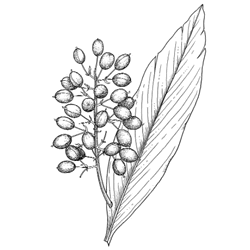
    Native ginger

    Native Ginger (Alpinia caerulea)

    The ginger flavoured pulp of fruits, stems and roots was eaten raw. The leaves were used to wrap around or add flavour when cooking. The fruit was opened and the filament was tasty but the seeds were spat out. Aboriginal pathways through the forest could be detected by the trail of discarded seeds.
    (Illustration by Janet Hauser) Text: reserve website


    Patricia is one of the volunteers at this Reserve and has been for 13 years.We had an interesting chat when I spent some time there yesterday. Horticulture has been running through her family for quite along time she explained... with family before her orchardists and farmers, she herself sometimes being affectionately known as "the little farmer" and a son in Horticulture. Living close by 2 decades or more the garden at Patrica's home is on an acre - part native garden as she is "devoted to australian natives", part a mix of plants from around the world. There's a dedicated rainforest area and a vegetable garden that I suspect is pretty good. You dont get called 'the little farmer' for nothing! Patricia's face was full of verve and passion as she talked of this garden and her previous one at her home in Nth Ryde, Sydney. I was reminded this part of Sydney was an important food bowl for the early European settlers and she assured me she kept that tradition alive in Ryde.
    Our conversation barely skimmed the surface ... I'm sure there would be a lot to learn from this clever woman!


    Callerya megasperma (F.Muell.) Schot
    Family Fabaceae - Faboideae


    This is a 'native wisteria' known  its likeness in appearance to the well known wisteria originating in Asia. The seedpod and seed above and below were sitting on the desk as I talked with Patricia.

    Callerya megasperma  - Native Wisteria

    read notes on this species at website:  Noosa's Native Plants


    Thankyou to Patricia for such enthusiastic engagement in the homage project and sharing stories ... thanks also to Pam at the front desk yesterday!

    PS Through a comment by artist Altoon Sultan I was reminded of the eminant Australian artist Lawrence Daws who has painted the Glass House Mountains often over many years since moving here. Googling his name I found this publication which I'm thinking can be found in the QLD State Library. His own website  www.lawrencedaws.com  is updated till 2005.


    Lawrence Daws: Asylum in Eden


    Lawrence Daws      Glasshouse Mountains 2001
    oil on canvas, 101.5 x 122 cm

    Monday, April 26, 2010

    enduring seeds - more from Gary Nabhan


    On the previous post I introduced books that I had found on the shelves of a local Brisbane library. The one that really stole my attention for the fact of it being so scholarly, beautifully written and of critical relevance was Gary Nabhan's  'Where our food comes from'.
    Since looking at his website I've found various other publications including the one above and a 5 minute audio "sowing seeds that will take the heat" dealing with an alternative idea to freezing seeds for seed banking by planting seeds in a desert farm in Arizona to develop seeds that will 'take the heat"!

    To read Nabhan's website visit here and visit his blog click here.

    some publications shown on the website.


    Where Our Food Comes From


    Sunday, April 25, 2010

    weekend reading


    A visit today to the Toowong Library resulted in some fascinating finds. The more reading one does on the history of where things of a botanical nature come from - especially now familiar and common edible things - the more intriguing and dense the stories seem to become. Books have been written about coffee, chocolate, portatoes, nutmeg and the list goes on. Plant derived foods that are now everyday kitchen items once sparked wars and gambling with lives to obtain.

    Mark Kurlanksy, in  book I found a few years ago titled "Choice Cuts" says
          "Food is about agriculture, about ecology, about man's relationship with nature, about the climate, about nation building, cultural struggles, friends, enemies, alliances, wars and religion."

    This is pretty much a short list of directions for consideration and research in relation to seeds - not just concerning food. Science definitely needs inclusion on this list - now more than ever! Out of curiosity I borrowed all these books below in order to see if and where seeds might feature in the discussion. This first title looks like be a must read...a short book...but possibly a good introduction to this topic. By the way, any reader who knows of these or other worthwhile related reads please do email or comment - It would be good to know more on this!

    Whilst at the dinner table discussion over some gems from Brillat-Savarin made for an interesting exchange. Particularly enjoyed his experiment with coffee making but so much more awaits the reader of this text! 
    An Aphorism from the Professor:  "The pleasures of the table are for every man, of every land, and no matter of what place in history or society: they can be part of all his other pleasures, and they last the longest, to console him when he has outlived the rest."

    A quick peek into Medieval Cuisine of the Islamic world was both seductive and peppered with interesting tales.

    Not yet gleaned anything about this title below!

    The Bunya Cookbook below I was particularly curious about as it was produced here in Brisbane specifically for the Aboriginal and Islander communities featuring indigenous ingredients where possible. I would like to elaborate more on this later.


    Perhaps the most remarkable book in this collection for its gritty future thinking WHERE OUR FOOD COMES FROM has a first chapter titled The Art Museum and the Seed Bank

    Before dawn on July 6th , 1941 a half million drawings, paintings, artifacts and ornaments from the great Hermitage were boarded onto the first train leaving Leningrad for sanctuary away from Nazi invasion which was eminent in this city. Six days it took in the planning and execution to get ready to send the Hermitage Art Collection into hiding - a collossol effort by hundreds called in to help - including the artists. Three blocks away on Saint Isaac's Square lay hidden a 2nd treasure trove - a Seed Bank of more than 380,000 samples of seeds, roots and fruits of some 25,000 species of food crops that had been collected by Russia's world class cadre of plant explorers since 1894.
    The story from here appears to be truly astonishing - the fact that the Bureau of Applied Botany is still there today and was not bombed in the 900 day seige by the Nazis that cost 1,500,000 lives. Known now as the N.I.Vavilov All-Russian Scientific Research Institute of Plant Industry it still harbours seeds and scientists. The Vavilov story is riveting - of a plant scientist who travelled to 5 continents in search of crop diversity and its importance in staving off famine - who met his end starved to death by Stalin despite or because of his legacy of plans for food democracy. Its a must read if the topic is of interest.


    Much more could be said of all these books. The last one above is a sobering story of one man's vision for dealing with the issue of farmer's rights, food democracy and food security 70 years ago. The future of seeds requires we address the quality of our global environment and the democratic right for all to access our global seed heritage.

    Click on text below to open and read about this book and the American based author who just won a Russian medal for this work which you can read about at islandpress.org and see more at his website
    garynabhan.com.
    .


    Below: this document of about 20 pages in length was produced around 2003, and if I recall accurately, presented at Terre Madre - the International Slow Food Conference/Convivium in Italy. Please correct this is you have further information!


    Sunday, March 21, 2010

    Marianne North: an extraordinary artist visits Queensland circa 1880


    Marian North (1830-1890) was born in Hastings England and travelled constantly with her father, an MP for Hastings, from 1855 after her mother died - resolving to paint the flora of distant countries after his death in 1860. A gallery for her work was built at Kew Gardens, London - opening in 1882. She travelled to Australia in 1880, apparently on the urging of family friend Charles Darwin. She was caught up in a most fascinating time in Botanical history and found herself with modest but substantial enough funds to do the extensive travel she became so well-known for through her Gallery that still stands and is a very popular destination for visitors. A remarkable life indeed!

    Inside the Marianne North Gallery. Copyright © RBG Kew

    This gallery interior hints at the massive collection of over 800 works she made in her lifetime. I came across her work on the www.kew.org site under collections, specifically Art images.
    It should be noted: she was far more likely to paint plant specimen in their natural context rather than to take a plant sample away from its habitat and then render it scientifically and clinically on a white page. By all accounts her work never suffered scientific inaccuracy even if she was working in situ in all kinds of climatic and geographical locations. This is cause for some serious thought - the work was relied on for its usefulness and accuracy in an age when cameras were not available for documentation and research purposes.

    'Foliage, Flowers, and Fruit of a Queensland Tree, and Black Coc. Copyright © RBGKew

    'Foliage, Flowers, and Fruit of a Qld Tree and Black Cockatoo'.
    Oil on Board Notes: this bird alone has a beak strong enough to crack open the nut of the Macadamia tree. 

    No. 767. 'Study of the Bunya-Bunya'.. Copyright © RBGKew

    No 767. 'Study of the bunya-bunya.'
    Click on title for notes by artist on this tree, its importance to indigeneous people, the seeds etc. On an earlier post I referred also to similar notes about cultural significance of this species. Read also about Bon-yi season here on the Homage to the Seed blog archives.

    'Nest of the Coachman's Whip Bird, in a Bunya-Bunya, Queensland'. Copyright © RBGKew

    'Nest of the coachman's whip Bird, in a Bunya-Bunya, Queensland.
    Oil on Board. Notes: The trees were full of these hanging nests of the Psophodes crepitans, made of the freshest green moss, and ornamented with the feathers of the common red and blue parrots.

    'View in the Botanic Garden, Brisbane, Queensland. Marianne Nort. Copyright © RBGKew

    'View of the Botanic garden, Brisbane, Queensland.
    Oil on board. Flowers of the Large Water Lily Nymphaea gigantea - water lily peculiar to Australia.

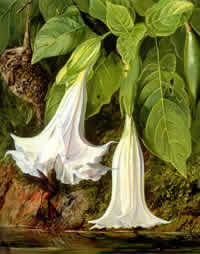
    "Flowers of Angel's Trumpet"
Brugmansia arborea 
by Marianne NorthMarianne North at her easel near 
Grahamstown in South Africa 1882

    For a brief but interesting account  of her life go to plant explorers.com - an interesting site with background into the early days of plant exploration - ancient Egypt, Babylon, Paradelos and China up to the 20th century. The Golden Age of Botany is referred to - perhaps a useful outline for a overview.


    Visit www.kew.org for further information about the gallery named in her honour and other work in her collection. If you click on Collections at the top of the website you can investigate the extraordinary range of collections of all kinds related to Botany. 

    Tuesday, March 9, 2010

    The archeology of the everyday


    Recently, time spent in the wonderful Library at the Botanic Gardens led me to an interesting journal publication


    Australian Garden History - where I read an article on the Archeology of the everyday which put forward the idea that not all archeology involves excavation or scientific analysis - garden ephemera such as plant labels and seed packets can yield vital evidence about past horticultural practices.


    Also mentioned was the book "Australia's quarter acre" by Peter Timms which was discussed for its examination of the backyard gardening tradition of this country with its chickens and chokos - so commonly replaced now with backyard blitz affairs (almost) straight from the store catalogues. The desire not to cultivate and mow a lawn year after year is an understandable change in thinking....perhaps more options need to be brought forward for consideration of how to best use this precious space.
    There is a timely awakening to our collective call to take more notice of the possible gains to be had from growing our own fruits, vegetables, herbs and such. In an earlier post I mentioned the children who are learning from school programs focused on kitchen gardens - complex and critically important learning that is having tremendous results for all concerned. There are stories of children asking to have some space to dig a garden at home, wanting to plant vegetables and eat them... Mothers are in shock !!
    Change is inevitable but few of us saw the velocity of change that we would be countering in 2010 nor did we probably imagine decades ago that the United Nations would be prompted to declare 2010 the International Year of Biodiversity.
    My grandfather farmed a small, fertile parcel of land in the Manning Valley of NSW in the 1920's through to the 1950's when he handed over to the next generation. Dairy, with produce grown from his own seed saving efforts (+ exchanges with relatives and neighbours) provided a modest sustainable income  - the produce being sold in the nearby town. In the Depression era many came looking for work for a meal - and this farm sustained many a visitor as well as those who gravitated to the daily table. As a young child I visited his "farmed" backyard garden with eyes of wonder. He'd retired into town and generated once again a prolific year round source of bounty... with grape vine trellis, a passionfruit vine on the water tank - organic produce and free range eggs - no labels required. From farm to fork indeed!


    Re the Peter Timms book - State Library of NSW shop:

    Below are images, stories and links to just a few of the many wonderful enterprises dedicated to preserving our seed heritage and ensuring those back yards will be places of bounty. More will be showcased over the year! Meetings are underway and you are warmly invited to add your imput, stories or contacts!

    Select Organic seeds come from Beechmont in the South East QLD region of Australia. I attended the huge vibrant annual Brisbane Organic Growers festival late last year and met the Finches who are behind this enterprise which also includes Eden seeds. These websites have links to many similar organisations and businesses. This region has an abundance of committed and innovative people who have worked hard to sustain wonderful intiatives over many years. 

    Select Organic packets

    These 2 images below are from a keen gardener at WWOOFblog who is studying permaculture and gaining experience through the WWOOF organisation. The seed saving process for heirloom varieties is explained alongside images. This blog has links to many related projects if interested.

    NZ spinach

    basil


    Home
    This organisation, founded in 1986 at Byron Bay, has managed to successfully  mobilise interest all over Australia and spread the word globally. Visit their website for an astonishing fount of information, links and also a blog to follow. Read their story here from their excellent website.

    From the archives: Nimbin 1989
    From these humble beginnings above to the current reach defined by the article below.


    Click on this article above to enlarge for reading. 
    Michel and Jude Fanton have seen their humble project build to its present  international exposure with books and films taking the message far and wide. This blog entry - 24th of january 2010 - details the film showing dates in New York this year.

    FORK TO FORK at HERONSWOOD

    This Victorian institution DIGGERS is well worth a visit. The slideshow above is from the cafe which runs a fork to fork club. Their wonderful catalogue is shown below.


    Related Posts Plugin for WordPress, Blogger...