Showing posts with label botanical illustration. Show all posts

Monday, September 6, 2010

Revisiting 'Ways of Seeing'

In March I posted on the varying ways we see the world. Lovers of the visual realm, literature and the arts in general get to appreciate this continually as we investigate new discoveries and revisit the old. Some of us are very eclectic in out tastes...whereas other may be more focused on a particular theme, style, genre or mood.

I wanted to make a link here to that March post for its broad ranging approaches to the botanical world demonstrated by diverse artists....most found at one source.


Picture 36
David Hockney

Mesembryanthemum_185_lg_2
Rudolf Blaschka


Tonight I also posted a story on Christchurch, New Zealand which contained  works from a various artists -all New Zealand artists past and present - one working with native plants as a subject for beautiful large pastel drawings. Click here to see that post.


Marlborough Rock Daisy I - Marilyn Rae-Menzies


Thursday, June 17, 2010

The latest Homage to the Seed artwork

You are warmly invited to attend the Group Show I am participating in from today June 17th through to Sunday, June 27th at Percolator Gallery in Paddington. To read more about the gallery and exhibition details do visit my Studio Archives blog.
I have borrowed heavily for this post from one I wrote yesterday at my long-running eclectic blog Sophie Munns: Visual Artist. .


This work above is shown below in context. The way I chose to hang the show is suggestive of a kind of dispersal of the pod forms featured in all the various works here. For the project I have been carrying out at Mt Coot-tha Botanic Gardens this year I have focused heavily on the forms found in the seed capules of the rainforest fruits native to Queensland. The Black bean motif I have long employed - finding a way to use it as a kind of scaffolding here in some of the works. This motif abstracted consists of 2 of the most essential or primal of forms... ovals and circles have, across Millennia, held enormous cultural significance... speaking to the subconscious mind powerfully and in our time simultaneously resonating with archaic yet contemporary meaning - with a life force still!


Acrylic and pigmented ink is the medium used and the canvas ovals come in four sizes - the smallest being 17.5 x 12.5cm as in the one below which features the hexagonal cross-section of the 'Pararistolochia australopithecurus' - a ribbed orange berry containing these 6 capsules for seeds....not that 6 seeds will always be found in each. That is something I'm still amazed by - despite the capsules that form in readiness to house seeds the number of seeds produced is not a given. Working in the Seed lab had really brought home the issue of seed viability..  pods may be pried open only to discover the absense of seeds non-vialbility of what is present.
The simple geometry of this species is completely uncontrived in this motif... its elemental and repeated in the most obvious of pattern-making. One cannot but help but think how much of this human love of geometry was fostered by saturation in the most common of everyday things in nature. Once upon a time when the human relationship to nature was for many so strong, and matters of survival meant nothing was taken for granted - seed had to be viable or it might spell disaster - plant breeding would have no doubt have come to rely on an almost scientific observation of what was occuring in nature in particular species. Acute observation may have made the critical difference. 
My long held fascination with ancient symbols has taught me time and again that the correspondance between the tangible and the abstract was deep-rooted and integral. No matter how sophisticated the tiled floors or wall patterns of antiquity appear - how mathematically complex - without doubt the starting point for a motif might be something as singular as a capsule which held seeds... like this one below. Its pause for thought.


The subtlety of the work below highlights three different seed capsules  - each a different rainforest species. This painting ( 35 x 28 cm ) refers to the largely hidden nature of seeds - they are not necessarily seen, more so if we never work with them, plant them, watch them grow. Because of this we can easily forget their mighty role in our lives... their tremendously important role as 'generator of life'. We can remain ignorant of their vast presence in so much that we consume daily... the debt we owe if you like.
And the most critically abundant of habitats for the wealth of biodiversity of these substances we so take for granted iare the rainforests of the world.


My challenge in making works during this year long project "Homage to the Seed" is to find a way to not simply make pictures like one might with a camera. Scientific Botanical Illustration has played and still does play an enormously important role in the research of species and all manner of knowledge. To some it may have appeared simply decorative, certainly exotic and capable of inspiring curiosity, a love of plants and therefore gardening.

Over the year I have researched in libraries and on-line for artistic as well as scientific visual interpretation of plants and ideas around plants.... keen to notice what representation of seeds occured... if any. The formal approach to scientifically presenting a Botanical specimen has often included the cross-section of the pod or capsule to display the structure, the seed - but this is largely secondary it would seem to the external appearance of the species.


Thus common thinking positions Botanical Art as a depiction of the seen form - the external over the internal structures...and certainly not concerned with implying the forces contained within. This is why the extensive work artist Paul Klee carried out on this rich vein of thinking has offered me a deeper strata of response to consider and grapple with.
Klee, influenced strongly by Goethe and a rich immersion from school days in things Botanical - at that time part of the regular school curriculum - went onto delve more fully in the many ways of seeing plants, growth and nature - not just a representation of external reality.
Curiously the thinking of Rudolf Steiner, also majorly influenced by Goethe, had for a time an interest for Klee. Kandinksy is said to have been immersed and stayed with Steiner's teaching whereas my reading suggests Klee left off at some point. 
Whatever the case - the notion of internal forces, things unseen, Dylan Thomas's "the force that through the green fuse drives the flower" has engaged my imagination and curiosity extensively and demanded attention over a long period... coming perhaps to fruition whilst focusing more deeply on seeds and paradoxically further exploration into the Scientific realm. Both have been driving agents and both extremely valuable.


This then has lead me to meditations on the place we find ourselves in on the planet at this time, seeking ways to interpret all that I have gleaned to date. The scientific approach..... observation, collection of data, theoretical propositions and such have been important to extract perspective on current concerns re biodiversity and the preservation of habitat and species..

But what then?
What do we humans value?
What do we as a global community care about plants?
What are we noticing and talking about?
What place are we giving this heritage?
Is someone supposed to do that for us?
My list on question goes on...its still shifting and turning. The sense of loss is enormous in the  plant heritage of this world - for habitats and for food. Both matter! Both are necessary to our survival....to breathe... to eat ... to have enough nourishment to live ...!

How do we shake our eyes awake? How do we get closer to what matters?

Below are 2 works - the larger one is the cross-section of mangrove seeds in their pod - Ariceunia marina (if I can read my journal writing correctly). Last year I walked through the boardwalk of a mangrove reserve - 12 kms from my house - on Moreton Bay. These seeds were everywhere at that time... and I picked them up off the path to look more closely before letting them fall into the water.
To think that locations where the mangroves had been decimated on Asian coastlines led to greater destruction by the Tsunami in 2004 is a clear reminder of the relationship between intact habitat and human survival. How wise is it for us to be thinking that because it is ... say christmas ... and we are on holiday, have money to travel and have "deserved"our fabulous holidays that the  environment will behave and let us have out nice time in peace.
Ramp up those travel packages where one participates in communities I say... being able to offer one's  self, getting to really know locals, volunteering for a time... reading of those who do this seems to equate with the most  rewarding of experiences.

I posted on the recent Tea and Seed Stories day in the Gardens at the homage blog and one of the central observations of the volunteer guides who conducted a children's art event and quiz to identify seeds with pods and foods was that the adults were most urgent to particpate in this quiz and many themselves did not know what they were seeing.

This was not the way once... we used to know where our food originated, and to worry that there would be enough because we knew about that too!


The smaller of the 2 images above is Mackinlaya macrosciadea
Many of the rainforest fruits I've been investigating this year are not edible, perhaps quite toxic but some able to be treated. Further still, there are myraid uses beyond food sources. I would argue that this kind of knowledge is easily as captivating as wine and cheese knowledge once one gets started, and of far greater significance for the long term. And be assured ... I am partial to a good red and fine cheese!

I will be posting more images and proper titles of works in the next days on the studio archive blog. Congrats if you read all the way to the end of this post ...your bottle of good australian red is in the mail!
You deserve it!


Monday, April 26, 2010

What species is that? Archidendron lucyi


This wonderful species Archidendron lucyi is found in the tropical rainforests of North Queensland as well as Melasia and the Solomon Islands. Also known commonly as scarlet bean it has the most fascinating structure - is about 70 to 120 mm long and 15 to 25 mm wide although the way it curls around disguises its length somewhat. On the following page of this excellent book below by Wendy and William Cooper is a very similar bean called the Salmon bean or Archidendron vaillantii. This is where the advice of staff at the gardens is critical due to the similarity between species - to an untrained eye its difficult to distinguish what is what. I like to double check wherever possible... as Jason Halford from the Seed lab (see post from april 19)  has stated at times plant identification can require quite a bit of cross-referencing for him to be sure. I expect I may have to edit posts over the year due to the limits to my knowledge. Already this has been the case after guided tours where so much is being taken in and notes and memory fail one. It's therefore reassuring to hear from experienced staff that they also can ocassionally make false readings first up.

IMG_0344 by stevenality.

You can appreciate the challenge in drawing some these forms. The colour is amazing and watching them opening truly spectacular. The seeds are a blue black and in a particular light can look satin-like which adds to the intrigue of this exotic fruit from the Nth Qld rainforest.


This single pod is typical of the way they curl around - taking up the space of the palm of one's hand.
This post was in response to the gardener/photographer Em from the wonderful weblog Garden Fool based in the state of New York. Thanks for your query Em which I will take up further this week at the Gardens with staff there.

When researching on this species I came across a remarkable website that contains a huge archive of images taken under the microscope of inside the wood of a diverse range of trees from around the globe. I have yet to read about this site in detail from North Carolina State University. Here is the image for the wood from this rainforest species above.

Click on this below to enlarge for reading:


This particular emtry comes from the Insidewood Images collection of North Carolina State University. The site was found through google but I am finding the links dont work to this when I try and enter them. You might find a way into  NCSU and then all collections  at:
 http://images.lib.ncsu.edu:8180/luna/servlet/allCollections?pgs=50&res=1


Aristolochia griffithii

As you can see the images from the inside wood collection are stunning and remind me of abstract 
forms not unlike ones I have been drawn to paint from time to time.


Thottea siliquosa


Daphnandra repandula


Gaura sinuata

Sunday, March 21, 2010

Marianne North: an extraordinary artist visits Queensland circa 1880


Marian North (1830-1890) was born in Hastings England and travelled constantly with her father, an MP for Hastings, from 1855 after her mother died - resolving to paint the flora of distant countries after his death in 1860. A gallery for her work was built at Kew Gardens, London - opening in 1882. She travelled to Australia in 1880, apparently on the urging of family friend Charles Darwin. She was caught up in a most fascinating time in Botanical history and found herself with modest but substantial enough funds to do the extensive travel she became so well-known for through her Gallery that still stands and is a very popular destination for visitors. A remarkable life indeed!

Inside the Marianne North Gallery. Copyright © RBG Kew

This gallery interior hints at the massive collection of over 800 works she made in her lifetime. I came across her work on the www.kew.org site under collections, specifically Art images.
It should be noted: she was far more likely to paint plant specimen in their natural context rather than to take a plant sample away from its habitat and then render it scientifically and clinically on a white page. By all accounts her work never suffered scientific inaccuracy even if she was working in situ in all kinds of climatic and geographical locations. This is cause for some serious thought - the work was relied on for its usefulness and accuracy in an age when cameras were not available for documentation and research purposes.

'Foliage, Flowers, and Fruit of a Queensland Tree, and Black Coc. Copyright © RBGKew

'Foliage, Flowers, and Fruit of a Qld Tree and Black Cockatoo'.
Oil on Board Notes: this bird alone has a beak strong enough to crack open the nut of the Macadamia tree. 

No. 767. 'Study of the Bunya-Bunya'.. Copyright © RBGKew

No 767. 'Study of the bunya-bunya.'
Click on title for notes by artist on this tree, its importance to indigeneous people, the seeds etc. On an earlier post I referred also to similar notes about cultural significance of this species. Read also about Bon-yi season here on the Homage to the Seed blog archives.

'Nest of the Coachman's Whip Bird, in a Bunya-Bunya, Queensland'. Copyright © RBGKew

'Nest of the coachman's whip Bird, in a Bunya-Bunya, Queensland.
Oil on Board. Notes: The trees were full of these hanging nests of the Psophodes crepitans, made of the freshest green moss, and ornamented with the feathers of the common red and blue parrots.

'View in the Botanic Garden, Brisbane, Queensland. Marianne Nort. Copyright © RBGKew

'View of the Botanic garden, Brisbane, Queensland.
Oil on board. Flowers of the Large Water Lily Nymphaea gigantea - water lily peculiar to Australia.

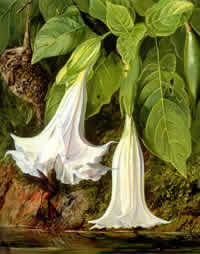
"Flowers of Angel's Trumpet"
Brugmansia arborea 
by Marianne NorthMarianne North at her easel near 
Grahamstown in South Africa 1882

For a brief but interesting account  of her life go to plant explorers.com - an interesting site with background into the early days of plant exploration - ancient Egypt, Babylon, Paradelos and China up to the 20th century. The Golden Age of Botany is referred to - perhaps a useful outline for a overview.


Visit www.kew.org for further information about the gallery named in her honour and other work in her collection. If you click on Collections at the top of the website you can investigate the extraordinary range of collections of all kinds related to Botany. 

Tuesday, March 16, 2010

WAYS OF SEEING - a visit to dear ada

       In the previous post I referred to the fact there are a great many approaches to Botanical subject matter in the Visual Arts. In the field of Scientific Botanical Illustration there is and no doubt always will be variation and invention, even in this most classical of arenas.
Ways of seeing indeed!
I thought I would highlight the curious and imagination directions of some artists working with botanical subjects in this post. However, I am going to start with several simple drawings from the children who came to my studio last year by way of introduction to / immersion in the multi-dimensional world where art meets botany.


The first work is by 7 year old Tom - perhaps worth clicking to enlarge this image - Tom was asked to draw something he liked and he jumped up and ran to the garden and came back with these camellias and nasturtium and a shell. I was intrigued to observe the careful layout of items that preoccupied him for a time then the extraordinary series of little texta images he created on the top right hand side of the page. He was totally engaged and only at the end did he look up, grow concerned and proceed to apologise for the smallness of the drawings, not that I was bothered by this. When it was time to go home he carefully carried the entire arrangement with drawing home as is here - his mother realising it was quite precious to him made sure it arrived home safely.
This entire procedure really fascinated me and it struck me that there was something quite powerful in this ritual that all of us could learn from. To see the deep absorbtion and the importance of composition, the artfulness in that alone was affecting.


Here in 12 year old Phoebe's work she collected leaves outside then observed and recorded the unique colours and features with care, painting each individually in a small notebook before the final invention - pasting them on a single stalk. On the one hand a simple process, but in another way, I saw her really take her time to appreciate the uniqueness of what she was looking at ... and I liked the whimsical and perhaps nonsensical twist at the end. It effectively draws attention to the uniqueness of each -  a curious way of completing her work.


Now I am taking you to the weblog Dear Ada (click on title to open) for a quick viewing of artists listed under botanical - garden in her categories. I would like to give the links to each individual artist here but that would take hours... so do visit the Dear Ada botanical link I have provided above and when you are free to trawl take a look at the links to the various artists. Apologies for not providing the details for wach artist here. The list starts with the extraordinarily talented Australian artist Fiona Hall and takes you to different parts of the globe, mediums and processes and styles of working. I hope you are intrigued and delighted as much as I was to survey the enormous variety in ways of seeing.


1. Fiona Hall
0015


2. Ruth Van Haren Noman
723


3. Ellen Goldschmidt
EG921


4. Qiang Huang
Demo at salado 1


5. Bill Beckley
B117

6.  John Baird
JB09_Floral_one_LORES

7. Sonnenschein Eliezer
2455865917_d56d2d6072

8. Neil Jones
Pea swipe

9. David Hockney
Picture 36
10. Hugo Guinness
18-A-Fine-Specimen

11. Not Known or identified
Mystery 3

12.  Joyce Tennyson
Intimacy_int_p11

13. Dam and Karislund Glas
HJ-SOFA-NY-08-Egg-Block

14.  Maarten Kolk
Doorgeschoten02
15.  Linda Broadfoot
Bdf120_LG


16. Malin Bjorklund
17. Scrapbook Floriegium
2632058173_e8919eb5b0

18. Daniel Williams
Safarisunset1_large


19.  Pamela Di Mauro
Perennial_spiritAllium_large_2
20.  Benjamin Long
Leviathan


21.  Dirk Mueggenburg
1


22. Gustav Oskar Andersson malme
Malmobo


23.  David Pearson
Greatloves11
24. Karl Blossfeldt
Aconitum_eisenhut_3Teucrium_botrys_2


25. Olga Seem
Duality08


26.alain gerard clement
Garden_6Garden_2


27.  Chris Hellman
Hellman_thepawnbrokers


28. Ric Heitzman
01palm_1


29. Becky Suss
528portfolios_quiltpainting


30.  Alice Stevenson
As1017


31. Judy Pfaff


Artwork_images_423779263_207830_j_2
32. Julie Blyfield
Blyfield_02


33.  Allan Ballie
41430


34. Nancy Blum
Small_drawings


35. Anna Atkins
Atkins_furcellaria_fastigiata


36.  Rudolf Blaschka
Mesembryanthemum_185_lg_2


37. Camilla Penti
Main7_2


38. Jennifer Scott
Picture_8


39. John Buck
Jb0301f


40.  Ernest Ciavano 
Ernesto_caivano_floral_veins_and_conduit


41.Ninagawa Mika
Acid_2
 I think you will agree this is an extraordinary range of works... and yet just the tip of the iceberg so to speak.  Thanks to Dear Ada for the peek into this fabulous array of wonderful artists and their work.  
Related Posts Plugin for WordPress, Blogger...