Showing posts with label botany. Show all posts

Saturday, April 20, 2013

House-hunting Saturdays

If you read my blogs you might already be aware that this is a transition time  and my studio is in storage temporarily whist we sell our home and relocate within Brisbane.

That means house hunting each Saturday and being ready for when our newly on the market home sells.


65 Reeve Street, Clayfield, Qld 4011
Our Clayfield home

 Recently this brought a rather unusual house that's currently for sale to my attention.


It didn't have the criteria we need... number of rooms etc, but I was determined to see it as the garden seemed quite spectacular and its incredibly unusual to see something like this in the area. 

There's been a rather extraordinary lack of trees and growing things in far too many places Ive seen. For me that is frankly concerning... and seeing such an abundant garden looking for a new owner is worth taking note of.


After walking through the gardens I said to the agent it was like being at Mt Coot-tha Botanic Gardens here in Brisbane and she looked at me and said ...well ...the owner is in Horticulture there... on of the Gardeners and thats why this is so spectacularly well done!


If this were my decision alone I'd be thinking hard about this property and VERY keen to see the garden preserved, I might worry about what might happen of I could't maintain it to this level of care and wonder... but I would certainly love to have a studio under the house and run classes there where participants could wander outside and draw from this amazing plethora of tropical vegetation and species.


 The back garden is mostly food growing area... and a grassy open space for contrast and recreation.


If in Brisbane you might like to tell anyone you know house-hunting at present and looking for a garden to enjoy... this one is pretty special and i shall be keen to see it find an owner who will cherish this botanical wonder!

Link to this house and garden: http://www.realestate.com.au/property-house-qld-chermside-113338175

Sunday, February 12, 2012

Russia’s promises to the world, Part 1


This share comes from an excellent new blog I found via twitter last night. Well worth a hop over there to read much more from VAVIBLOG. But here's a taste...

vavilov3.jpg
Nikolai Vavilov

Russia’s promises to the world, Part 1

by JEREMY on APRIL 5, 2011 · 0 COMMENTS
The Director of the Vavilov Institute, Nikolay Dzyubenko, reminded participants at last week’sberry meeting that the Russian Federation had made firm commitments to share its genetic resources with the world. He mentioned two recent statements by political leaders, and thanks to the good offices of Sergey Alexanian, Vice Director for International Relations at the Vavilov Institute, we can share them here.
4110457440 bfc89e3baf mSpeaking at the World Summit on Food Security at FAO headquarters in Rome in November 2009, the Minister of Agriculture Yelena Skrynnik said: “Russia supports the collective efforts of the world community in their struggle against hunger, and … As an explicit contribution to the solution of this task, Russia is ready to commence the procedure of incorporating the renowned unique global plant genetic resources collection of the Vavilov Institute into the system of the International Treaty on Plant Genetic Resources for Food and Agriculture.”
Not too sure how that’s going.
Photo Copyright FAO.
Ive written about Vavilov before ... these notes are from Wiki:
Nikolai Vavilov

Nikolai Vavilov
BornNovember 25 [O.S. November 13]1887
Moscow, Russian Empire
DiedJanuary 26, 1943 (age 55)
Saratov, RSFSR, Soviet Union
NationalityRussian
FieldsBotany
Genetics
Nikolai Ivanovich Vavilov (Russian: Никола́й Ива́нович Вави́лов) (November 25 [O.S. November 13] 1887 – January 26, 1943) was a prominent Russian and Soviet botanist and geneticist best known for having identified the centres of origin of cultivated plants. He devoted his life to the study and improvement ofwheat, corn, and other cereal crops that sustain the global population.
Known for
Centres of origin

Tuesday, November 9, 2010

slow circles of nature....


"Everything that slows us down and forces patience, everything that sets us back into the slow circles of nature, is a help. Gardening is an instrument of grace."


May Sarton

This quote was found at: Art Propelled Tumblr which is well worth a visit. Image below was also found at that site.


Botanical Notes by Tor Archer
Botanical notes by Tor Archer


Page from the Book of Broken Branches by Patti Roberts-Pizzuto
http://missouribendstudio.blogspot.com/2010/10/sticks-and-stillness.html
page from the Book of Broken Branches by Patti Roberts Pizzuto
also found at Art Propelled


Stunning image by Olaf Hajek
Olak Hajek


kiktomo:

anyu:

craftstream:

halslife:

tinywhitedaisies:

scrumtrulescent:

(via lauraseymour, bagel)
found at Indigenous Dialogues

The image above can be traced to Lynn El/Una Odd at Flickr.


Leeks2 by Lynn_EL/UnaOdd
Chasmanthium latifolium by Lynn_EL/UnaOdd
 by Lynn_EL/UnaOdd
Sedum by Lynn_EL/UnaOdd
Epimedium by Lynn_EL/UnaOdd
 by Lynn_EL/UnaOdd
Horseshoe Pit cover by Lynn_EL/UnaOdd
Mirabilis jalapa seed by Lynn_EL/UnaOdd
Striped pumpkin skin by Lynn_EL/UnaOdd
Basket detail by Lynn_EL/UnaOdd
Euphorbia myrsinites by Lynn_EL/UnaOdd
Cabbage by Lynn_EL/UnaOdd
Viburnum by Lynn_EL/UnaOdd
Clematis seedhead by Lynn_EL/UnaOdd
Allium tuberosum by Lynn_EL/UnaOdd
Tricyrtis pods 2 by Lynn_EL/UnaOdd
Pinecones silver and red by Lynn_EL/UnaOdd
Rue pods and stitches by Lynn_EL/UnaOdd


darksilenceinsuburbia:

Fractal Botanics by Karl Blossfeldt
Via
Karl Blossfeldt - Fractal Botanics

Thursday, September 9, 2010

botanical alchemist - in town soon...


india flint 

botanical alchemist  : author of ECO COLOUR
with
marianne hall + roz hawker
for one night only 
exhibition in conjunction with a
sold out 5 day bio regional dyeing workshop led by India 

  
 Saturday 18 September    5pm – 8 pm


frocks , wraps and fabric lengths, works on paper and sterling silver pieces

e: rozhawker09 at gmail dot com


You can read much more here at India Flint's website
and at her blog

where you will discover why this is such a wonderful opportunity 
to go and meet this renown artist and see her work 
along with that of 2 others who are collaborating on this occasion.
Such a shame this workshop has sold out.... ages ago I might add...
you could twist her arm to come back to this part of the globe... perhaps!


Im leaving you with this last image from India's blog...  your mission , should you choose to accept, is to wander over and see what the significance is of this  image!                                                  

Monday, September 6, 2010

Revisiting 'Ways of Seeing'

In March I posted on the varying ways we see the world. Lovers of the visual realm, literature and the arts in general get to appreciate this continually as we investigate new discoveries and revisit the old. Some of us are very eclectic in out tastes...whereas other may be more focused on a particular theme, style, genre or mood.

I wanted to make a link here to that March post for its broad ranging approaches to the botanical world demonstrated by diverse artists....most found at one source.


Picture 36
David Hockney

Mesembryanthemum_185_lg_2
Rudolf Blaschka


Tonight I also posted a story on Christchurch, New Zealand which contained  works from a various artists -all New Zealand artists past and present - one working with native plants as a subject for beautiful large pastel drawings. Click here to see that post.


Marlborough Rock Daisy I - Marilyn Rae-Menzies


Sunday, August 29, 2010

a closed door and a secret garden...

Wednesday afternoon was spent in the library at the Gardens at Mt Coot-tha searching for various titles, one or two books were found I'd borrowed before and now with a little more time available the hope to do more reading has returned.

A quick check at the Seed lab found the door locked and no one at home. This was quite expected as Jason Halford, resident Seed Technician was still due back from his Northern Qld Seed-collecting mission.


I happened to bump into Gardens Caretaker Tony who had saved some seeds from a rather exotic bean  from Indonsesia he had grown to give me for my collection. I have forgotten to photograph these...which were quite a lovely shade of pale carmine.  While he was finding the seeds I managed to have a browse around his personal garden which is not really a secret...the hedge shown here is very low and all who habituate this 'behind the scenes' area are able to view his accumulating succulents and the particularly spectacular rock shingle borders he builds.
These circular and walled rocks were beautifully done and I immediately thought of places I saw in Scotland many years ago... Tony reminded me he is from Yorkshire... but asssured me they have their rock walls in abundance there too.... which I can recall if I think about it.


In a slightly secluded courtyard area that gets much summer sun are the plants below which caught my eye for the colours and various fascinating forms of the plants. Thank you to Tony for the interesting botanical diversion and adding something to the collection!


Wednesday, July 28, 2010

the long history of connection between art and botany


Capri  by Joseph Stella


Recently I visited the fascinating HUMAN FLOWER PROJECT via the blog 'not all those who wander are lost' of  South Australian based textile artist (botanical alchemist) of enormous talent and renown India Flint.


botanical alchemy on the line and in the book form - a must see!


ABOUT the HUMAN FLOWER PROJECT:

The Human Flower Project is an international newsgroup, photo album and discussion of humankind’s relationship with the floral world. We report on art, medicine, society, history, politics, religion, and commerce. Written and photographic submissions are welcome.
Since its inception in September 2004, the Human Flower Project has been non-commercial, focussing rather on research, news gathering, commentary, and visual documentation. I hope to present worldwide perspectives on this topic and welcome contributors of all ages and nationalities. Julie Ardery

This Project is the brain child of Julie Ardery - a sociologist and writer in Austin, Texas. I was overwhelmed by the wealth of material at this site... and suggest a good visit when you have time. I know  often we like to shown a lot of images and not need to wade through the text... blogging after all lends itself so beautifully to the visual arena of life.

Anyone drawn to flora in art-making and design ..... this site is a little like adding rich nutrients to your garden of ideas...  here is something to mine and to ponder. Seriously worth a look!


From the mourners of a Neanderthal man buried with flowers in 60,000 B.C.. to today’s megawatt floral designers on HGTV, people have turned to flowers out of anxiety, necessity and joy.
By studying flowers, we look into human emotion and value. Since the flower trade is global, and has been for centuries, by following the circuit of plants across the world, we track international relations and economics.
Seeing how artists represent flowers, we re-experience what it is to be living temporarily, alongside life in many forms different from ourselves. Julie Ardery

I bookmarked numerous articles but will share this today!

First up:  In Architecture, Ancient Plants Grow - (archive 16 feb 2009)  an article written by Russell Bowes who looks back several thousand years to the papyrus, palms, lotus and acanthus still rooted in the world's building styles. Bowes is a garden historian and lecturer based in London.


Stylized papyrus blooms top columns  Ramesseum—Luxor, Egypt

Photo:via wiki


By Russell Bowes
Ornamentation of a building is not strictly necessary.  Doors, windows and walls function just as well plain as decorated.  Yet for thousands of years, people have turned the structural parts of buildings into naturalistic and stylised depictions of local plants and flowers.
Was this for the joy in decorating plain surfaces?  Or did the leaves and fruits have deeper meaning? Perhaps ancient buildings speak to us in a language we no longer hear, with words we no longer understand.


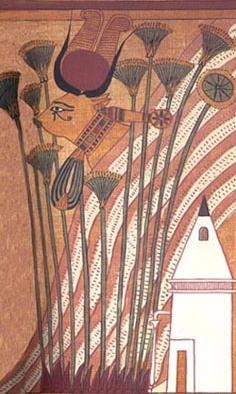
File:Hathor with sacred eye in papyrus.JPG
Goddess Hathor stalks through papyrus plants, from Papyrus of Ani
Photo: via wiki


The earliest Egyptian builders worked in a landscape inhospitable to trees.  Thin soil, negligible rainfall and constant desert winds don’t support large stands of timber; thus, buildings constructed entirely of wood were extremely rare.  In the millennia before the widespread use of stone as a building material, with wood at a premium and with relatively crude hand tools unsuitable for working what little timber was available, the ancient Egyptians used more abundant materials which were more workable with the tools they possessed. 
The Egyptians staple building material was made from bundles of reeds, woven with palm fronds for added tensile strength and liberally smeared with layers of mud from the Nile. Palm leaves, however, are not completely flat but curve at the tip, and these curved tips were often left poking free of the structure at the tops of walls, forming a curved ‘architrave’ between the uppermost section of the wall and the roof. In centuries to come, when walls were made of stone blocks, this curve would be translated into stone, becoming the cavetto cornice which is such a distinctive feature of Egyptian architecture.  Often painted to resemble a row of palm fronds, they served constantly to remind the later Egyptians of their architectural heritage. 
Read more by clicking on the website above and going to the
archives for the date I posted... for some reason this in not opening as per usual at the article page. I thought this excerpt below was a fascinating reminder of the difference between originating and copying ideas...  the Romans subsuming the Greek cultural legacy.
The native flora of Egypt and Greece profoundly influenced the buildings each culture created.  The effects were both stylistic and symbolic, with each country’s buildings honouring their gods and paying homage to indigenous creations myths.  The Romans, having subsumed the forms of Greece into their own culture, with sometimes little or no understanding of the ideas that lay behind them, exported their adopted architectural styles around their empire.  The use of the principal elements, in decorative terms, reappeared throughout time and around the world.
Years ago I did my own appropriating of ancient forms as part of an investigation of how intrinsic symbols were in the ancient world. I was interested in the perrenial fascination with form  - the way that symbol still speaks to us even when meaning is lost or not apparent. Staying 4 months in Greece in 1987 and travelling to Egypt the following year I was able to indulge in my passion for these ancient cultures at some length.


Sophie Munns: 'ancient , but reverberating still'


The other article I wish to highlight  JOSEPH  STELLA'S  RESOLUTION  is posted on the 13 of january 2009.

This article brought to mind the bloggers who make a resolution to do a painting a day or something similar. Apparently Stella also did this - Im not sure for what length of time - perhaps throughout his life. What stands out for me is that he felt such a strong necessity to 'buck the system' whilst at art school (and no doubt afterwards). Painting flowers was forbidden where he studied and steel girders were definitely the order of the day. Julie Ardery writes this after becoming aware of the 'human flower project' as she puts it that Stella embarked on.


“...that my every working day might begin and end, as a good omen, with the light, gay painting of a flower.”
Joseph Stella called this his “devout wish” (My Painting, 1946)—synonymous, we’d say, with a resolution.
We came upon Joseph Stella’s resolution this fall, visiting the Smithsonian American Art Museum. His articulation of a human flower project was printed on the wall label below Neapolitan Song, painted in 1926 – four years after Stella had revisited his beloved Italian homeland.

Neapolitan Song
Neapolitan Song (1926), by Joseph Stella

Smithsonian American Art Museum, Washington, D.C.
From the little we know of him, he seems to have mustered this resolution and followed throughearly in his career, bucking considerable peer pressure to do so. Studying at the Art Students League in 1896 (hotbed of early Modernists) he bridled at the academy’s “rule forbidding the painting of flowers.” Low-life in the city and steel girders were the order of the day ( actually Stella was quite good with girders, too). By 1897 he had moved to the New York School of Art to work with William Merritt Chase, a pro-flora painter to be sure.
(For much more about the artist and his floral works, see Joseph Stella: Flora, the text available online. It catalogues an exhibition held January 8 - March 6, 1998 at Eaton Fine Art, West Palm Beach, Florida, and includes a long essay by Barbara Rose.)
Catalogue of Joseph Stella, Flora
Eaton Fine Art, Palm Beach, Florida


Reading about Stella’s life, we wonder if he didn’t suffer from Seasonal Affective Disorder, as the gray winters of New York and, later, Paris, really got him down. He seems to have required periodic infusions of sun and green to keep on working: a long visit in Venice, the Naples trip, and late in life, a journey to Barbados. We think it also probable that each of us carries a special affinity for the climate, the colors, and plants of our childhoods. For a painter, this affinity would reasonably be intensified, in some cases amounting to a kind of craving – Van Gogh for his irises, water lilies and palms for Joseph Stella.
As for his devout wish – to paint a flower every day – what a sign of health, to turn personal necessity, no matter how quirky or against the grain, into an explicit plan. May all our resolutions be as honest and as clearly consummated.

... well ... plenty to explore at the Human Flower Project.Thanks to India I found my way there and hope you might too!


To read more on this subject click here to go to a just posted article at my other blog.
Related Posts Plugin for WordPress, Blogger...