Showing posts with label ecology. Show all posts

Thursday, July 21, 2011

Eco Colour ... from land far south-west of here!


I am flying in with a quick post... although I could spend ages putting a post together on the work of India Flint I will link you instead to some sites where you can explore things yourself. She needs no introduction to many... but just in case ... from the home page of her website:

"i am an artisan and writer specializing in bio-regional ecologically sustainable plant dyes ...welcome to my workroom"


* india's photo of the workroom in the territory


And what a workroom it is... dessert floor, hotel sink, plane seat or kitchen table ... the tone of everything she does is authoritative without the attitude... the real thing one might say. 
And not only that... she makes space for others, shares endlessly, is widely and sometimes rudely and outrageously appropriated without acknowledgement ...but then has the chutzpah to set things straight in style with no nonsense!


She is a conduit between past and future ... and oh how we need people of authentic vision and application like hers... in every single facet of human life at this time. Essentially her work is midwifing a whole deeper sense of what's possible for using what we find in nature around us... and in our neighbourhoods, homes and cupboards for that matter.


india's photo ... sharing


Nothing is surface... nothing in excess. All so artfully and continually brought in and pieced together... part of a continuity of cultural practices on the one hand and a pioneer on the other. Go explore... see what I mean. Many are continuing or refinding a love of fabric, textiles and such they inherited from family and community... all round the globe people industriously pursue this tradition... or innovate things anew. 
Perhaps without India though... we might not have seen such a singular need to do it with such enormous shared integlligence and depth of learning... with vision for the artfulness of each part of the working, teaching and sharing process.... words and all!


India's photo ... from her life on the move!


india's photo ... botanical alchemist at large


india's photo... earth is close by.


For anyone unfamiliar with the work dip into India's blog for entry into a fascinating world of making colour and cultivating a practice that extends from her land out into the whole world. In gentle, coaxing, indirect ways our minds are engaged and habits challenged. Each part of the work and living is so utterly responsive to the challenges of this time... it its an intelligent reminder and call to each of us to ask ourselves ... what of us?

Colour's long shaped my life ... ever since my parents gave me colour pencils aged five. Perennially its the thing most have commented on about my work - for good or bad. In Melbourne from 1994 to 1998 I offered consecutive Tuesday night 8 week courses 'Colour workshop' at the Collingwood shop-front Studio business I ran as Themata Studio. More recently I've been reminded how challenging my class exercises were (thankfully they used the word fun too) when I would ask the group to draw the smell of coffee or the feel of raw wool or some far-fetched thing.

What was going on for me in those classes was my need to address the distance between the world and us... between nature and us... our senses and our minds.... between colour and feeling. This was my laboratory and I was finding my way back to the things that mattered in my own art work..and I was bringing people along for the exploration... humbly knowing all the long that I was learning far more than I was teaching!

The depth of India's immersion in colour and ecology could lead me to be immensely intimidated by how little I know. But I'm not covetous...  awe is more the word. Grateful people like her bring these things to life that they choose to live by, share what they've learned, and give people an opportunity to be saturated in valuable ideas in exchange for the rewards of doing that. If anything I take inspiration from her to go back and pull together the most worthwhile learnings of my own unfolding practice and experience.... to be more fully conscious of and engaged with the processes that are arising out of my own nature and relationship with nature.... whatever the limitations of those two things are.

The prize we need to be looking to, at this time in human history, is surely to be working in the direction of sustaining the natural inheritance we came into this world able to appreciate. Nothing is so valuable, so priceless as the living systems into which we were born. Our greatest task is to see ways to be active participants in the challenge to preserve what we possibly can... no matter what we do or where we are.

Monday, December 13, 2010

Inspiration for Monday morning!

Whilst visiting Abigail Doan's wonderful blog this morning I found two article's I wanted to post on here. Read about her at the greenmuseum.org. She describes herself as:

"a writer and environmental fiber artist residing in NYC and Europe. 
My eco-textile and art farming projects are a means to create sustainable 
solutions and visual links to the global challenges we collectively face."

 This eco-art blog I like to visit for inspiration featured artist Kevin Inkawhich some time ago and the Seed Project which I'll focus on  as well.


'Kevin Inkawhich crafts the most heart palpitatingly natural mobiles. Using dried leaves, seeds, pods, branches, and delicate wire armatures, his floating sculptural pieces make any room or exhibition space flutter with organicism. They are lyrical, resourceful, and an homage of sorts to the fact that the best design is always, in essence, nature-based.'


silho-03-23-.jpg
Kevin Inkawhich

 Also at Abigail's blog:


Ruth Asawa in her San Francisco studio via Community of Creatives

this article below on Abigail Doan is well worth a read:

Returning to and from THE LAND: Connectivity and Crafting Residency


ABIGAIL DOAN

THE LAND/an art site is located eighty miles southeast of Albuquerque in the
pinon and juniper-scented foothills of New Mexico's Manzano Mountains. The pueblo mission ruins of Salinas National Monument are situated nearby, as is the train-whistle-punctuated town of Mountainair, the former pinto-bean capital of the world and the now faded hub of the Santa Fe Railway. As THE LAND's September 2006 artist-in-residence, I prepared myself for an immersive week of surveying and studying the unique characteristics of this remote art and conservation site.


all images form the Land Views site.

also from Landviews:

Abigail Doan is an environmental artist and activist. Her work has been exhibited in conjunction with the United Nation's Environment Programme, Art into Action/The Natural World Museum, and in group exhibits worldwide. Abigail is a contributing editor to Supernaturale.com, where she writes about art farming, craft, and the use of fiber in the landscape. She recently exhibited her 'Crocheted Snow' series at Lafayette College's Williams Center Art Gallery, in an exhibit called, "On Ice". Her work appears on Greenmuseum.org, in periodicals such as Knit Knit, and in the recently published book, Craftivity. Her 'Tumbleweeds' will be exhibited this April in the show, "Stretched Threads", at The Atlantic Center for The Arts in Central Florida. For more information on Abigail's projects, go toabigaildoan.blogspot.com.


NOW... the next thing I wanted to share found at Abigail's blog was this:


http://abigaildoan.blogspot.com/2007/04/seed-project.html


SeedHeader4.gif
watch this one minute video!

Sp1.gif


Matthew Gehring


Monica Hernadez


Joan Fitsimmons


Gina Fuentes Walker - apple seeds


The Seed project began in 2006 by David Cohen, an installation artist.


The Seed project engages people all over the world plant to plant seeds creatively, creating individual art projects. The growth is then documented digitally. The digital images are compiled and placed together to form a “Virtual Field”  that can be seen  online. The components of the actual field exist in many separate places at once; sort of a diaspora of plants.
The plants can be grown freely in any configuration the planter chooses and the images can express the individuality of the grower as well. Planters are also free to choose to grow whatever seeds they choose. The three criteria are that the plants must be:

1 non-spreading,
2 non-invasive and
3 grown legally.
When a person participates by planting the seeds they become connected to a collective group of artists and activists. There are opportunities to meet potential collaborators and work creatively on other projects separate from the Seed Project. The seed becomes symbolic of these new collectives. 


CarmenJournalpage.gif
School project


Anyone can join in this seed project!

Thursday, September 9, 2010

botanical alchemist - in town soon...


india flint 

botanical alchemist  : author of ECO COLOUR
with
marianne hall + roz hawker
for one night only 
exhibition in conjunction with a
sold out 5 day bio regional dyeing workshop led by India 

  
 Saturday 18 September    5pm – 8 pm


frocks , wraps and fabric lengths, works on paper and sterling silver pieces

e: rozhawker09 at gmail dot com


You can read much more here at India Flint's website
and at her blog

where you will discover why this is such a wonderful opportunity 
to go and meet this renown artist and see her work 
along with that of 2 others who are collaborating on this occasion.
Such a shame this workshop has sold out.... ages ago I might add...
you could twist her arm to come back to this part of the globe... perhaps!


Im leaving you with this last image from India's blog...  your mission , should you choose to accept, is to wander over and see what the significance is of this  image!                                                  

Tuesday, June 1, 2010

in recent weeks...in the studio and meeting visitors at the Gardens


On June 18th I will be showing work with 9 artists at Percolater Gallery, Paddington, in Brisbane. So recent weeks have been spent working with ideas that came from the work for the recent show in April/May.To see the full post titled "today" I wrote on that click here. More on the Percolator show VERY soon!


...work in progress and the Homage to the Seed journal I'm keeping above and below - the Cooper rainforest book I mentioned is also open above. I was very keen to get on with painting but felt the need to go back through the Cooper book, freshly documenting, with very quick sketches and brief notes, some interesting forms in the the capsules and seeds of various species. I'm loving this way of becoming more familiar with the biodiversity of the rainforests and similarly rich habitats... recognising the enormous numbers of species and seeing the variations that can occur just through this simple research is so fascinating to consider. Tonight, noticing an indigenous version of nutmeg and reading that it has little scent led to wondering about the extraordinary discoveries that people made through Millennia, the risks when identifying if something was edible, what properties it had and so on.

I'm finding ethnobotany more and more fascinating and realising that its piecing together some of my own various passions for knowledge that to date didn't seem to link that well.


For this group show I have chosen the distinctive oval shape canvases which mimic the pod and seed forms somewhat. I find them compelling shapes that sit well with this subject matter. Although working with them on and off for a few years they seem to have grown on me - that lovely but strange, organic thing that happens when concept, subject and form merge a little. 
Producing small works for a group show I felt the cohesiveness of the ovals would hold the  viewer's focus. Perhaps they remind me a little of looking under the microscope in the Seed lab where the image is circular and the surrounding darkness means you can only see what is contained within the circle of light. The subject matter is intimate and contained in this shape. Egg - seed...the biological connection is so strong! 
oval |ˈōvəl|
adjective:  having a rounded and slightly elongated outline or shape, like that of an egg her smooth oval face the game with the oval ball.noun:       a body, object, or design with such a shape or outline cut out two small ovals from the felt. DERIVATIVESovality |ōˈvalitē| |oʊˈvølədi| |-ˈvalɪti| nounovalness |ˈoʊvəlnəs| nounORIGIN mid 16th cent.: from French, or modern Latin ovalis, from Latin ovum ‘egg.’


Both these works feature the cross-sections of rainforest fruits from Queensland - however the one below is probably not going in the show. Its was a curious experimental work that came from the starting point of the cross-sections but with a life force all its own. It was as if it was bursting open... the seed capsule cross-sections sprouting to life and when I first did 2 works like this I was rather unsettled and decided I didn't like what was happening in them. Now I find it less odd and will see what comes through over the year - if more work like this seems to want to burst through with a mind all of its own.


This is the flyer for the upcoming group show - 10 artists - 10 days exposing the Brisbane Artists Development Co-operative. To read much more about this and the venue visit the studio blog.


AND NOW - RECENT VISITORS TO THE GARDENS FROM TOWOOMBA:


10 days ago, give or take, I had a wonderful visit at the Botanic Gardens from some wonderful members of the Darling Downs Textile Artists - Pat Sloss, Marion Curry, Jen Luck, Jenny Burgess, Margie Creek, Joan Ellard, Stephenie Broadbent and Nicki Laws. They were in town to see the exhibition of Inga Hunter's work then came out to the gardens at Mt Coot-tha to see work in progress with the residency. A viewing of paintings and visual diaries, recent and older, allowed them to see the progression from past research into ancient symbols and other influences, water and fluidity from years living on the Newcastle coastline, to working with seed motifs particularly after moving to Brisbane, research through the lab, gardens and library to finished artwork as part of the Homage to the Seed  year.
They wrote later of how they discussed the overlap in approaches despite their using different materials to myself (textiles vs paint or ink) and how they also related to the approach of layering, colour and repeated motifs.This group practice varied textile techniques, but a common theme seemes to be the environment and human impact on it. They have always recycled and reused extensively and many use natural dye sources on fabrics and thread. The members live in or near Toowoomba and most have some strong connection to farming, past or present. 


I talked of the need to understand the source of our foods, the threats that come from global business monopolies, especially in the area of seeds, and the issue of biodiversity. These women live with these things daily in front of their eyes - so all these themes are discussed at meetings frequently. A frightening reality they spoke of was the large portion of Queensland’s good farming land being currently at risk of coal mining or coal seam gas extraction. This problem they said is literally now ‘in their backyard’ with the potential massive loss of flora and fauna, damage to water reserves, as well as community fragmentation.
DDTA -Darling DownsTextile Association has been together for about 10 years and runs the biennial ‘Progressions’ juried contemporary textile exhibition. The beautiful Darling Downs starts an hour and a half west of Brisbane - and is currently where the mining expansion is taking place. Bunya Mountains are not far off...a place I have been curious to get to. I have posted on this extraordinary idigenous Bunya Pine tree and source of food before.


Fighting to keep Acland alive - click on the 7.30 report 

Questions were raised about the town of Acland, now Stage 3 expansion is being considered, which may take a year or more to go ahead. One of the group wrote to me to say

         "New Hope Coal plans to level the town, divert Lagoon Creek for 5 km etc In preparation they have bought and removed 95% of properties in town. There is some excellent plantings in town - mostly indigenous but also introduced. Lots of majestic bottle trees. Also nearby Bottle Tree Hill with dry vine scrub. Is seedbanking an option when an area is to be wiped off the map? If you want any more info I can point you in the direction of the Stage 3 EIS and list of flora species"


Proposed open-cut mine site 24th March 2010


NB: I later asked questions raised here about seed banking before a place is levelled and found that in certain cases certain Laws demands that a company take full responsibility for seed banking and replanting (after the area has been mined) to restore. I have not as yet found out if that will be the case here. Jason Halford at the Seed Lab said it was indeed the kind of situation where it is of primary importance to seed-bank.


The group at the discussion


Two of the wonderful members of the group. I was treated to viewing the works of several textile artists. Below is work from Nicki Laws - (seen above right - Joan Ellard on the left). I was delighted to see what results had come from the use of various seeds and leaves and the fabric choices and various processes employed. A trip to visit the group at some stage and really see them in action is a must I think. I had temporarily lost my camera that day so missed getting shots of work some had brought along to show. More please ladies. I am putting in an official request to have a blog post on your seed related work!


This was such a rich exchange. For someone to have such a fine audience and then receive such an excellent show of ideas and stories in return is a wonderful experience! It made me only too aware, all over again, of the brains trust of so many living on the land who are in tune with their environment.  These are the people who are seeing the ecological shifts in daily life... they recognise the losses occuring... they have had family farms or still do and work with the land, sensitised to its needs, in whatever ways they can. What a privilege to have their visit!

Tuesday, May 4, 2010

The Glass House Mountains and Mary Cairncross Scenic Reserve


This is the wonderful view from the roadside opposite Mary Cairncross Scenic Reserve just outside of Maleny, an hour north of Brisbane. To read a brief history of the traditional owners before and since white occupation click here and on European pioneer history read here. The Glass house mountains were so named because Captain James Cook passing by in the Endevour in May, 1770 thought they looked like the glass-making furnaces near his home in Yorkshire, England.


click on images to enlarge for viewing


The Reserve website has a bushtucker guide which is of particular interest in regard to the Homage to the Seed Blog. The image below is from an article on wild food - also known as bushtucker. The top left corner features the large green bunya pine.


Bunya pine
Bunya Pine or Bon-yi Bon-yi

(Araucaria bidwillii)


This was an important food. The nuts were eaten raw although generally roasted whole or after pounding into a meal. Seeds were also buried in mud until they sprouted, then roasted for a better flavour. The thick end was then cracked with a stone, "otherwise it would go off with a pop and shoot everywhere". The trees fruit most abundantly every three to four years. On these years, large numbers of Aboriginal people gathered at nearby Baroon Pocket Dam to feast on these nuts, arrange marriages and initiations, settle tribal disputes and hold corroborees. Some men had usufactory (harvesting) rights to specific trees.  Text: reserve website


Photo above taken on walk at Botanic Gardens , Mt Coot-tha in February.

Native ginger

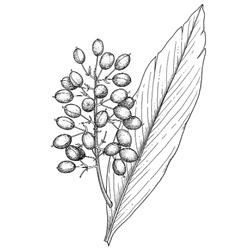
Native Ginger (Alpinia caerulea)

The ginger flavoured pulp of fruits, stems and roots was eaten raw. The leaves were used to wrap around or add flavour when cooking. The fruit was opened and the filament was tasty but the seeds were spat out. Aboriginal pathways through the forest could be detected by the trail of discarded seeds.
(Illustration by Janet Hauser) Text: reserve website


Patricia is one of the volunteers at this Reserve and has been for 13 years.We had an interesting chat when I spent some time there yesterday. Horticulture has been running through her family for quite along time she explained... with family before her orchardists and farmers, she herself sometimes being affectionately known as "the little farmer" and a son in Horticulture. Living close by 2 decades or more the garden at Patrica's home is on an acre - part native garden as she is "devoted to australian natives", part a mix of plants from around the world. There's a dedicated rainforest area and a vegetable garden that I suspect is pretty good. You dont get called 'the little farmer' for nothing! Patricia's face was full of verve and passion as she talked of this garden and her previous one at her home in Nth Ryde, Sydney. I was reminded this part of Sydney was an important food bowl for the early European settlers and she assured me she kept that tradition alive in Ryde.
Our conversation barely skimmed the surface ... I'm sure there would be a lot to learn from this clever woman!


Callerya megasperma (F.Muell.) Schot
Family Fabaceae - Faboideae


This is a 'native wisteria' known  its likeness in appearance to the well known wisteria originating in Asia. The seedpod and seed above and below were sitting on the desk as I talked with Patricia.

Callerya megasperma  - Native Wisteria

read notes on this species at website:  Noosa's Native Plants


Thankyou to Patricia for such enthusiastic engagement in the homage project and sharing stories ... thanks also to Pam at the front desk yesterday!

PS Through a comment by artist Altoon Sultan I was reminded of the eminant Australian artist Lawrence Daws who has painted the Glass House Mountains often over many years since moving here. Googling his name I found this publication which I'm thinking can be found in the QLD State Library. His own website  www.lawrencedaws.com  is updated till 2005.


Lawrence Daws: Asylum in Eden


Lawrence Daws      Glasshouse Mountains 2001
oil on canvas, 101.5 x 122 cm
Related Posts Plugin for WordPress, Blogger...